
AI Token Pricing: The Seller Sets Both the Price and the Quantity
← Back · ACT II · Chapter 7: Value Is Not Promised; It Is Proven
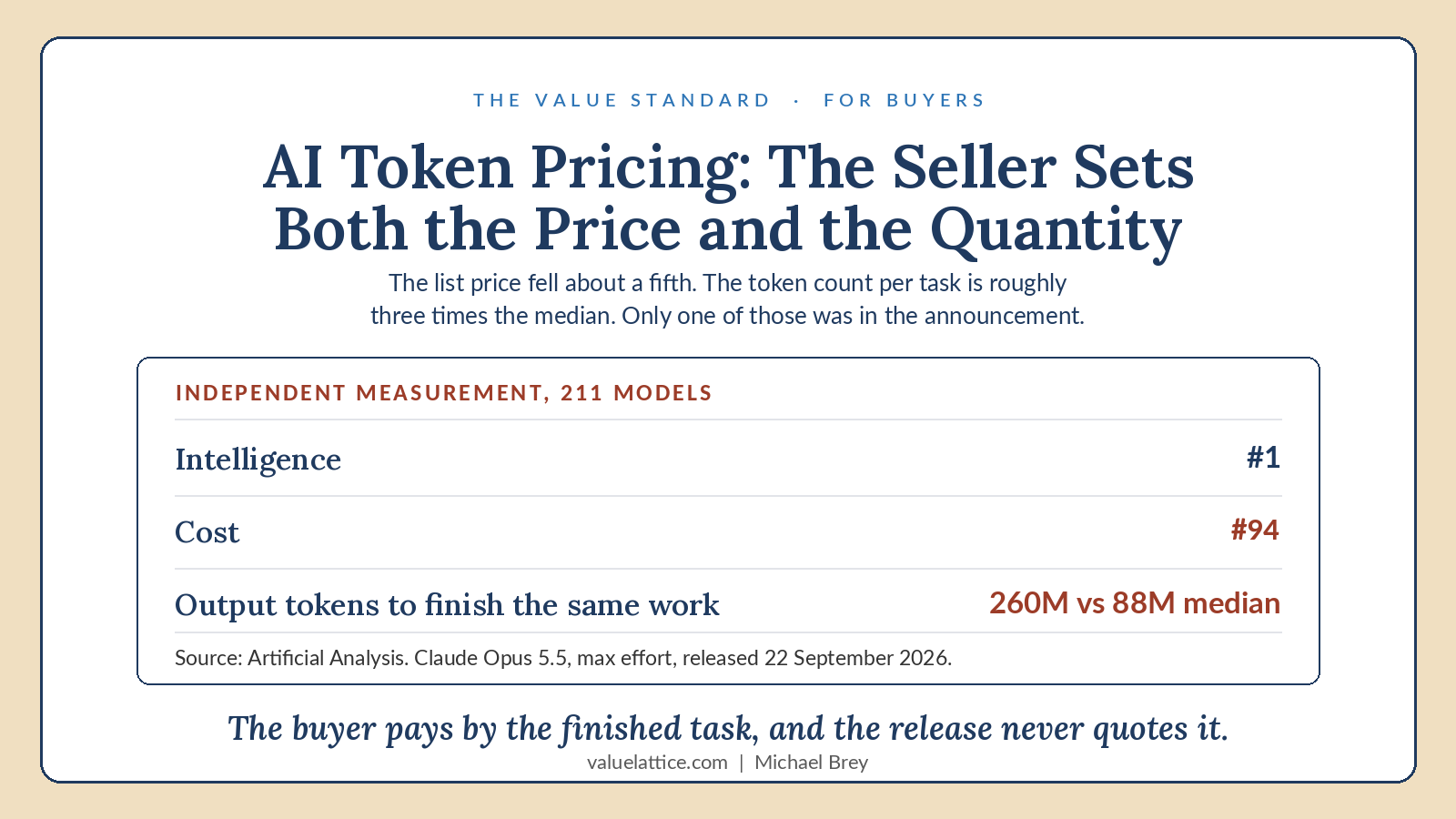
The list price of the leading model fell by about a fifth while it spends roughly three times the median number of tokens to finish the same work, and only one of those numbers was in the announcement.
On 22 September two frontier laboratories shipped new models minutes apart, and both releases led with cost. Anthropic put Claude Opus 5.5 at four dollars per million input tokens and twenty per million output, down from five and twenty-five. The trade coverage settled on a single reading within hours. The frontier is being commoditized. Intelligence is starting to be priced like cloud storage. Every quarter you get more for less.
That reading is comfortable and it is half a sentence short. Cloud storage is a commodity because the unit holds still. A gigabyte is a gigabyte whoever sells it and whatever the vendor ships next quarter. A token is not that kind of unit. The buyer pays by the token, and how many tokens a task consumes is a product decision made by the seller.
Artificial Analysis measures models itself rather than reporting what the laboratories report. Its page for this release carries both numbers, a few lines apart.
Two Numbers, One of Them Advertised
On the Artificial Analysis Intelligence Index, Opus 5.5 at maximum effort ranked first out of the two hundred and eleven models listed on 25 September 2026, scoring 58 against a median of 26 for comparable models. On cost it ranked ninety-fourth of the same two hundred and eleven. The page sums it up in its own words as “amongst the leading models in intelligence, but somewhat expensive when comparing to other models of similar price.”
The reason sits in a line most readers will scroll past. Running the index, the model generated 260 million output tokens. The median for comparable models was 88 million. Roughly three times the output to finish the same evaluations, billed at the twenty dollar end of the meter rather than the four dollar end. Artificial Analysis puts the measured cost of one task on that index at $5.98.
So the list price came down by a fifth and the quantity went up by a multiple. The seller sets both the price and the quantity, and only the price was in the announcement.
Cheaper Than Last Year’s, and Cheap, Are Different Claims
Anthropic’s own figure is that the model costs about forty percent less to run than its predecessor on typical workloads. Nothing in the independent measurement contradicts that, and it is worth saying plainly rather than leaving as an insinuation. The two statements answer different questions.
One compares the product against last year’s version of itself. That comparison is the seller’s to define, and it is the one that goes in the release. The other compares it against everything else a buyer could run, which is the comparison a buyer actually faces. A buyer who reads the first and behaves as though it answered the second has taken the measure from the party being paid, which is the habit this whole argument is about.
The vocabulary problem underneath it is older than this release. The market adopted the term unit economics before it defined it, and a buyer who waits for the vendor’s definition is already arguing on the vendor’s terms. What this release adds is that the definition can be settled and the buyer can still be exposed, because the unit was never the thing in dispute. The count was.
What the Independent Measurement Is Actually For
The verbosity figure is not a criticism of the model. A model that spends more tokens thinking may well be worth it, and on this index it finished first. The point is narrower and it is about who produced the number.
No buyer commissioned that measurement. It exists because a third party decided to run the evaluations itself and publish the method. Strip it out and a buyer comparing releases has vendor-reported benchmarks, a vendor-defined efficiency claim, and a price list. Every input to the decision would have come from the parties competing for it.
In the category absorbing the fastest-growing share of technology budgets, the evidence a buyer decides on is mostly supplied by the sellers, and the one instrument that is not is a side project nobody in the purchase pays for.
The federal government has now made the same dependence part of its own contracts. In March 2026 the Office of Management and Budget told each agency to ask its current IT vendors for “information about the agency’s utilization rates and prices paid,” and to write into new contracts a requirement for vendors “to disclose utilization and pricing information to the Government.” As a way to see what agencies are using and paying for across government, that is a sensible step. It also means the government’s count of its own consumption starts with the seller’s meter, and the memo does not define utilization.
The Unit the Buyer Should Be Watching
Cost per token is the seller’s unit. Cost per finished piece of work is the buyer’s, and it moves with product decisions the buyer does not make and is not told about. A model that gets twenty percent cheaper per token and forty percent more verbose has become more expensive while every headline says the opposite.
The answer is one thing written down before the purchase, which is less work than a spreadsheet: what this spend is supposed to produce, in the organization’s own words, with a figure and a date, so that a number computed from the seller’s meter can be checked against something the buyer authored. A ninety day proof deadline has the same hole in it, and falling prices widen it, because nothing gets terminated for failing a test that was never written.
A price cut is easy to see. What it cost is a separate question, and the buyer is the only party with a reason to ask it.
Artificial Analysis, model page for Claude Opus 5.5 (Adaptive Reasoning, Max Effort, Default Fallback), read 23 September 2026 and re-checked 25 September 2026: artificialanalysis.ai/models/claude-opus-5-5. Intelligence Index v4.3.2, ten published evaluations, methodology published. The prior list price of $5.00 and $25.00 per million tokens and Anthropic’s own figures of about forty percent lower running cost and thirty percent faster output are the vendor’s statements, reported in trade coverage, and are named as such above.
Office of Management and Budget, Memorandum M-26-10, Reinforcing Transparency, Accountability, and Oversight of Federal Technology, March 2026, Section 2: whitehouse.gov.
Keep reading: ACT II · Chapter 7: Value Is Not Promised; It Is Proven
The Standards Ledger
Some topics need more room than a blog post. Those go into The Standards Ledger, a free newsletter by Michael Brey, sent through Substack. Subscribers get one long essay by email about every six to eight weeks, and each issue also stays online to read later. It is written for the people who approve purchases and answer for what they deliver. Unsubscribe anytime.
On LinkedIn, follow Michael Brey or the Value Lattice page.