
Ninety Days to Prove AI Value
← Back · ACT II · Chapter 7: Value Is Not Promised; It Is Proven
An analyst firm has put a deadline on proof, and nothing in the advice says where the claim being tested comes from or whose words it is written in.
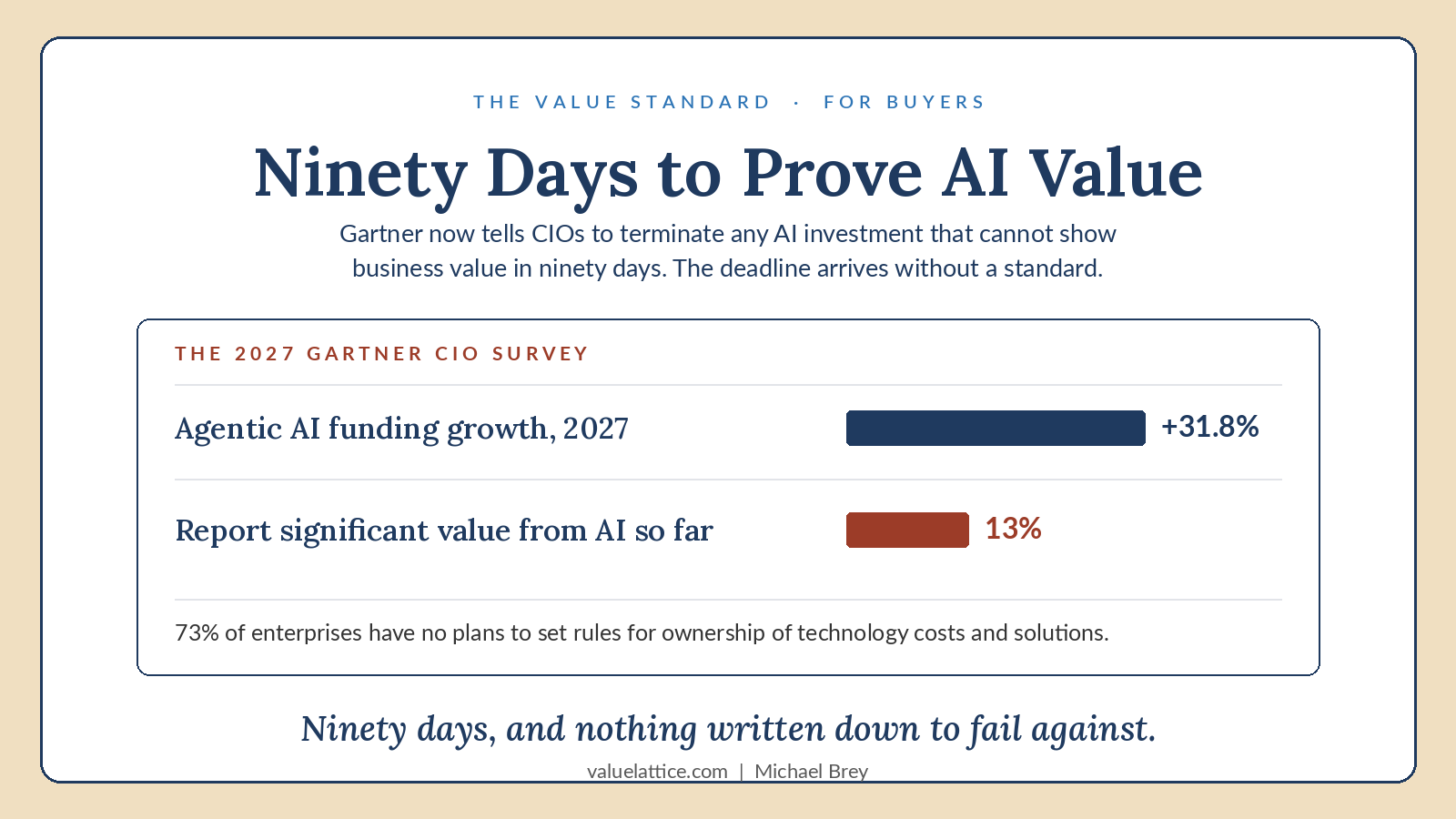
Gartner published its 2027 planning guidance for CIOs on 31 August 2026, and among the recommendations it put a clock on proof. Require every AI investment to demonstrate business value within 90 days or face termination. Coming from an advisory firm that sells to the same executives approving the spending, that is a direct instruction and it deserves to be taken seriously.
The numbers underneath it are more interesting than the deadline. In the 2027 Gartner CIO and Technology Executive Survey, 58 percent of CIOs report growing pressure to deliver AI-driven cost savings, while 51 percent expect AI to raise total cost of ownership across the life cycle. Only 36 percent believe they will meet their cost-reduction targets. Thirteen percent report significant value from AI tools so far. Funding for agentic AI is set to rise by an average of 31.8 percent, the fastest-growing investment area in the survey, against overall IT budget growth of 3.7 percent.
Read those together. Spending accelerates hardest on the category the organization already knows, by its own account, it is least able to show a return on. A ninety-day deadline is one response to that. What it leaves untouched is the reason the gap opened in the first place.
A Deadline Is a Schedule
Ninety days says when someone has to come back with an answer. It does not say what the answer is about, who wrote the question, or what counts as having met it.
On most enterprise software purchases all three arrived from the supplier. The benefit case that justified the spend was assembled by the party being paid, presented during evaluation, and negotiated around on price and terms rather than on substance. Ninety days later the organization opens that file and finds the supplier’s definition of success sitting where its own should be. The review runs on schedule. It confirms what the proposal said it would confirm, or it produces a reason the timing was unfair, and the number that started the whole thing goes unexamined either way.
More frequent reviews will not lift that thirteen percent on their own. The reviews have to be running against something the organization wrote.
Seventy-Three Percent Is the Load-Bearing Number
The same survey reports that 73 percent of enterprises have no plans to develop rules for ownership of technology costs and solutions. An average of 15.3 percent of technology solutions are already built outside central IT, and 80 percent of technology executives expect AI to increase the number of business-developed solutions by 2030.
Ownership of cost is the smaller half of that problem, and it is the half most organizations will fix first, because it is tractable. Cost leaves a trail. Somebody raises the purchase order, somebody approves the invoice, and years later anyone who cares to look can find the number. The benefit the purchase was approved on leaves nothing comparable. It is written once, in a document assembled to get a decision made, filed, and never opened again by anyone under an obligation to open it.
So a rule about who owns the cost still leaves the claim unowned. The organization gains a name against the spend and has nobody holding the promise the spend was justified by.
What Goes In Before the Purchase
The correction is small and it goes in early. Before the decision is made, the buying organization writes down what this spend has to produce, in its own words, with a figure and a date. Not the vendor’s benefit case restated in the buyer’s template. Not a success criterion that arrived inside a proposal. One statement the organization authored, entered in the record, and required to be reopened on the date it names.
At ninety days that statement is what the review runs against, and the test can then return a negative answer, which is the whole reason for having one. Without it, a proof deadline is a calendar entry and a meeting.
None of this needs new technology or a governance program, only one line in the file that belongs to the buyer.
Where the Advice Stops
The advice goes further than the deadline, and it deserves credit for that. Gartner tells CIOs to partner with CFOs to define enterprisewide AI economics, including ownership, accountability and value realization metrics, and to measure AI performance on overall business outcomes. That is sound advice for the portfolio. Where it stops is the single purchase. The article does not mention a vendor, a contract or a business case, so it never says where the claim a ninety-day review tests comes from, or whose words it is written in. On most purchases that claim arrived with the supplier. The buyer replaces it, before signature, in the record, once.
That is the part the survey keeps measuring from the outside. Thirteen percent report significant value. Nothing in the survey says the other eighty-seven percent concluded that the technology failed. Where nobody on the buying side wrote down beforehand what a purchase was for, a ninety-day review has nothing it could fail against.
Gartner has set the deadline. The standard it runs against is still the buyer’s to write.
Related reading: AI Token Pricing: The Seller Sets Both the Price and the Quantity
Gartner, “CIO Planning for 2027: Close the AI Ambition Gap”, 31 August 2026, reporting the 2027 Gartner CIO and Technology Executive Survey. gartner.com/en/articles/cio-planning-for-2027. Gartner does not publish sample size, respondent titles, countries or fieldwork dates for this survey in the public article; every figure above is attributed to the survey as Gartner names it.
Keep reading: ACT II · Chapter 7: Value Is Not Promised; It Is Proven
The Standards Ledger
Some topics need more room than a blog post. Those go into The Standards Ledger, a free newsletter by Michael Brey, sent through Substack. Subscribers get one long essay by email about every six to eight weeks, and each issue also stays online to read later. It is written for the people who approve purchases and answer for what they deliver. Unsubscribe anytime.
On LinkedIn, follow Michael Brey or the Value Lattice page.