
Post Series
Each series published on LinkedIn, collected here as it runs. Click a series name to open it, then “…more” on any post to read it in full.
Eight posts on what a buyer-held record of results does for the vendors who deliver, taking their objections one at a time. Seven published so far.
When a purchase works, the vendor usually has no record of it that a buyer would trust.
We built a lot of business cases on the vendor side. A customer hits the number, everyone is pleased, and two years later the only proof is a case study the vendor wrote about itself. The next buyer reads it the way they read every case study, as marketing.
So at the next evaluation, the vendor that delivered sits beside a competitor that has only promised, and the two proposals look about the same. Each brings references and an ROI model. What neither brings is a result the buyer’s own side defined up front and checked afterward.
That part belongs to the buyer, and changing it does more for good vendors than most people expect. Once the buyer writes down what the purchase has to produce, with a baseline and a date, the vendor that delivers finally has evidence it didn’t write itself.
Some vendors will push back on that page, and some of the pushback is fair. Over the next few weeks I’ll take the objections one at a time: outcomes the vendor doesn’t control, who owns the baseline, whether it slows the deal, what it does to price, and what it means for those of us who built the cases.
The page is the Request for Value. How vendors are likely to respond to it is here: https://valuelattice.com/how-your-vendors-will-respond-to-a-request-for-value/
The vendors with real results have been competing without their best evidence for a long time, and most of them know it.
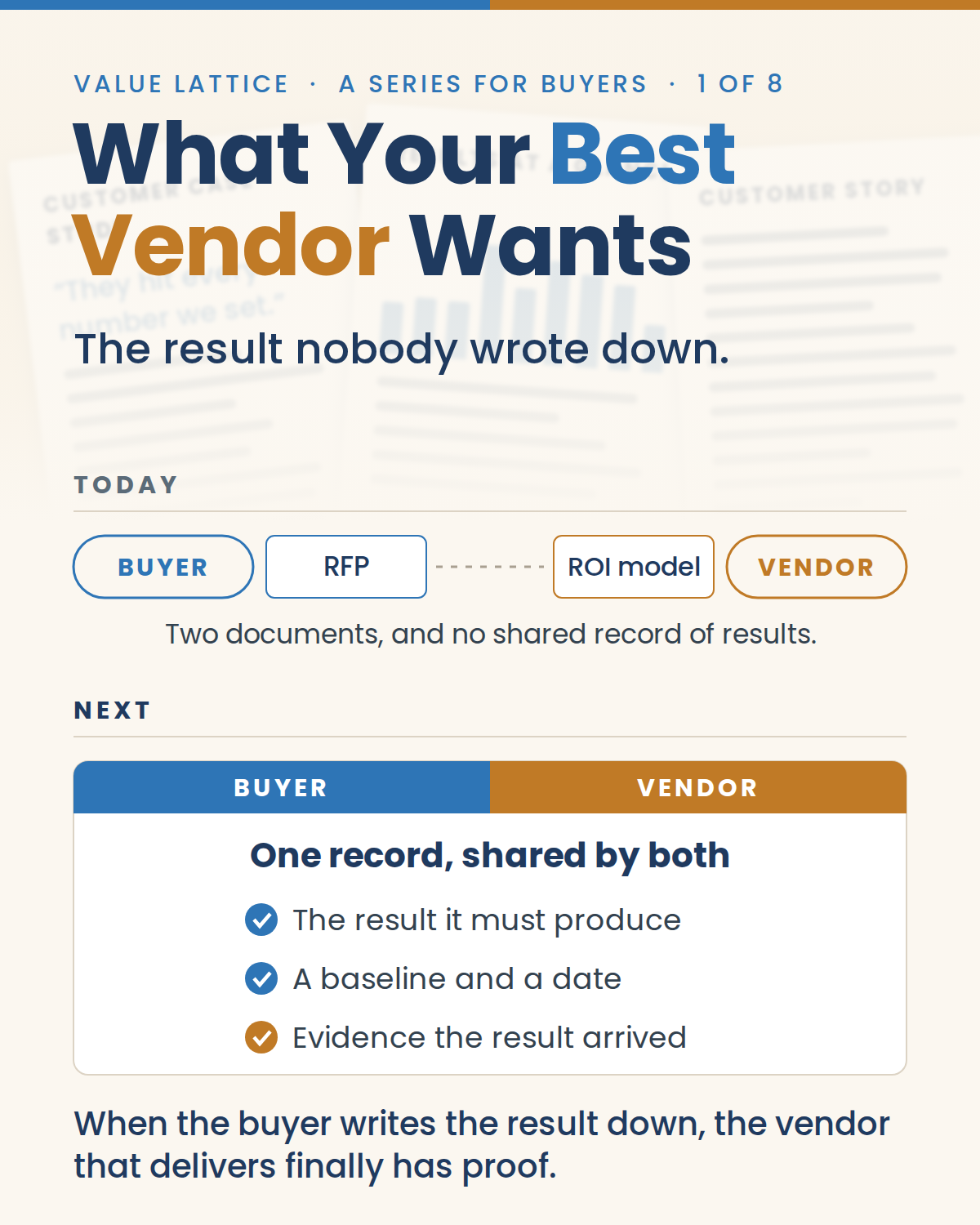
The fairest objection a vendor will raise is that it can’t promise an outcome it doesn’t control.
It’s true, and we said it in plenty of deal reviews on the vendor side. A new system cannot cut order errors if the customer’s team keeps entering orders the old way. No vendor should sign up for a number that rests on someone else’s behavior.
The usual fix is to drop the outcome and measure what the vendor does control: uptime, response times, the go-live date. Those are worth tracking. They also let a purchase pass every check while the reason for buying it never shows up.
There is a better answer. Before signing, the buyer writes down what has to be true on its own side for the result to arrive: the process change, the clean data, the people who will use it. The vendor is then held to an outcome whose conditions were stated, not to a number that assumed a perfect customer.
When the result misses, the review has somewhere to start. Either a condition on the buyer’s side failed or the vendor’s part did. Today that conversation tends to end with two slide decks, each explaining the other side.
A vendor that delivers its part has every reason to want those conditions on paper. It is the only way a miss on the buyer’s side stops being counted against the vendor.
The conditions line is one entry on the Request for Value. The rest of the vendor objections are here: https://valuelattice.com/how-your-vendors-will-respond-to-a-request-for-value/
Most outcomes depend on both sides doing their part, and right now only the vendor’s part ever gets written down.
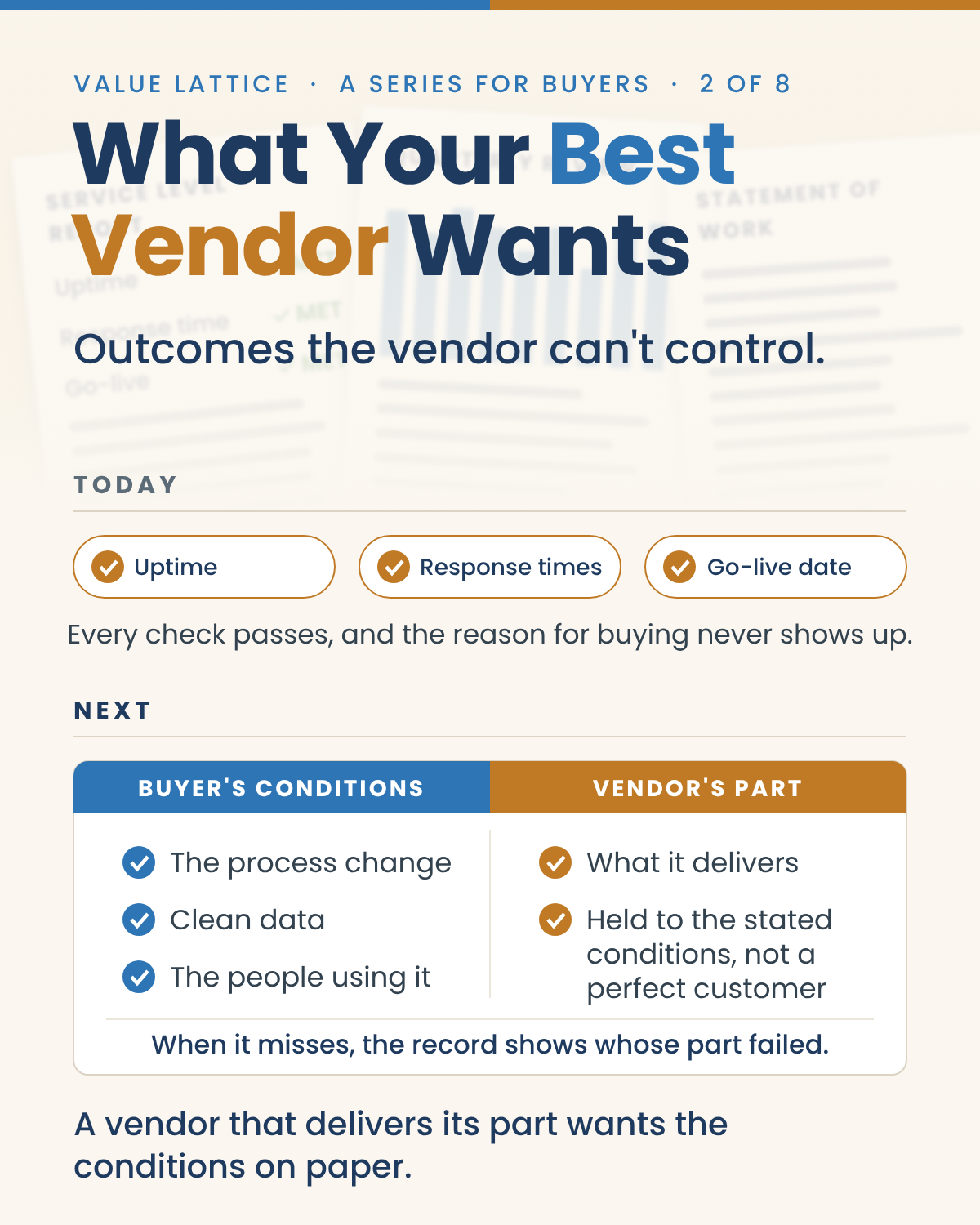
Every result gets measured against a starting point, and on most purchases the vendor is the one who supplies it.
It usually comes in the business case. On the vendor side, we built those baselines ourselves, from a discovery call, a couple of industry benchmarks and whatever numbers the customer could pull together that week. They were honest estimates, but they were ours, and nobody on the buyer’s side ever wrote down that they agreed with them.
That catches up with everyone about a year in. If the result looks thin, the vendor can point out that the starting point was worse than anyone realized, and the buyer has nothing of its own to set against it. A strong result has the opposite problem, because no one can say how much of it the purchase caused.
The newest version shows up in usage-priced AI deals. The buyer gets to choose what counts as success, which sounds like control, while the counting still happens inside the vendor’s platform.
The fix is a little tedious. Before signing, the buyer measures the starting point from its own records and shows it to the vendor while there is still time to question it. A vendor that delivers gives up nothing here. Its improvement is counted from a number both sides accepted, so nobody can argue the gain away afterward.
The baseline is one entry on the Request for Value. More on who keeps the count: https://valuelattice.com/you-bought-the-outcome-who-owns-the-number/
Whoever holds the starting number tends to end up deciding what the result was.
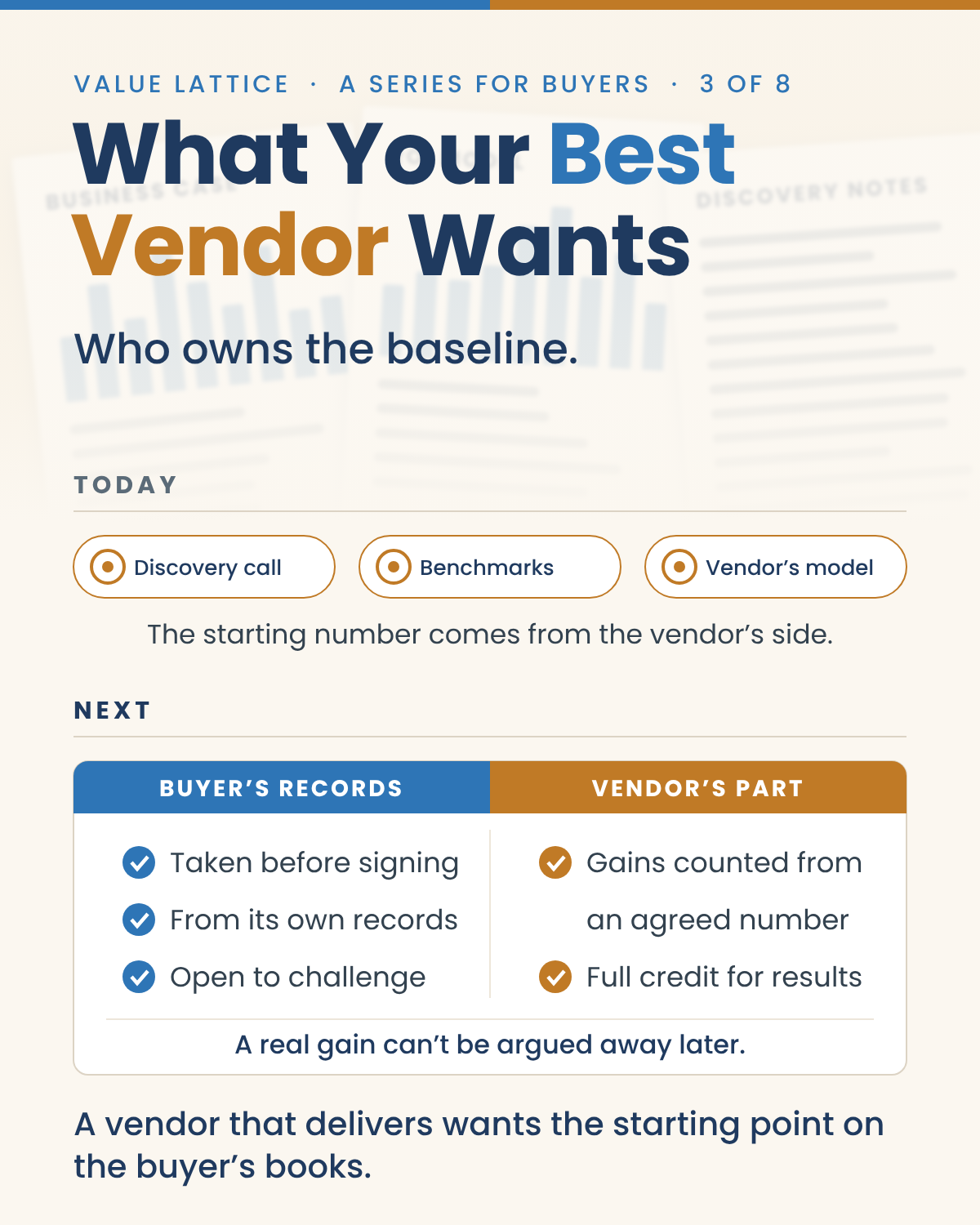
The objection a Request for Value hears most often comes from the buyer’s own side: this will slow the deal down.
I understand why. The RFP is written, the evaluation team is booked, and now someone wants the business owner to stop and write down what the purchase has to produce.
That sentence is slow to write for a reason. Finance is after lower cost. Operations wants fewer emergencies, and IT would like one system instead of three. Each of them signed off on the same requirements list, because a list of features lets everyone read their own purpose into it.
On the vendor side we ran into that disagreement in discovery, when three people from one customer each described a different problem, and we wrote proposals wide enough to cover them all. It came back after go-live, when the steering committee couldn’t agree whether the purchase worked because it had never agreed what it was for.
The page moves that argument to a working session before any vendor is called. Without it, the same argument runs for months after the contract can no longer change.
It saves the right vendors time too. A seller that knows what it is being compared on can say early whether it fits, and one with results against that kind of outcome gets to lead with them.
The first line of the Request for Value is that outcome, in the business’s own words. More on why it doesn’t slow the deal: https://valuelattice.com/the-argument-about-what-you-bought-happens-anyway/
Every purchase gets its argument about purpose, and most of them have it after the money is spent.
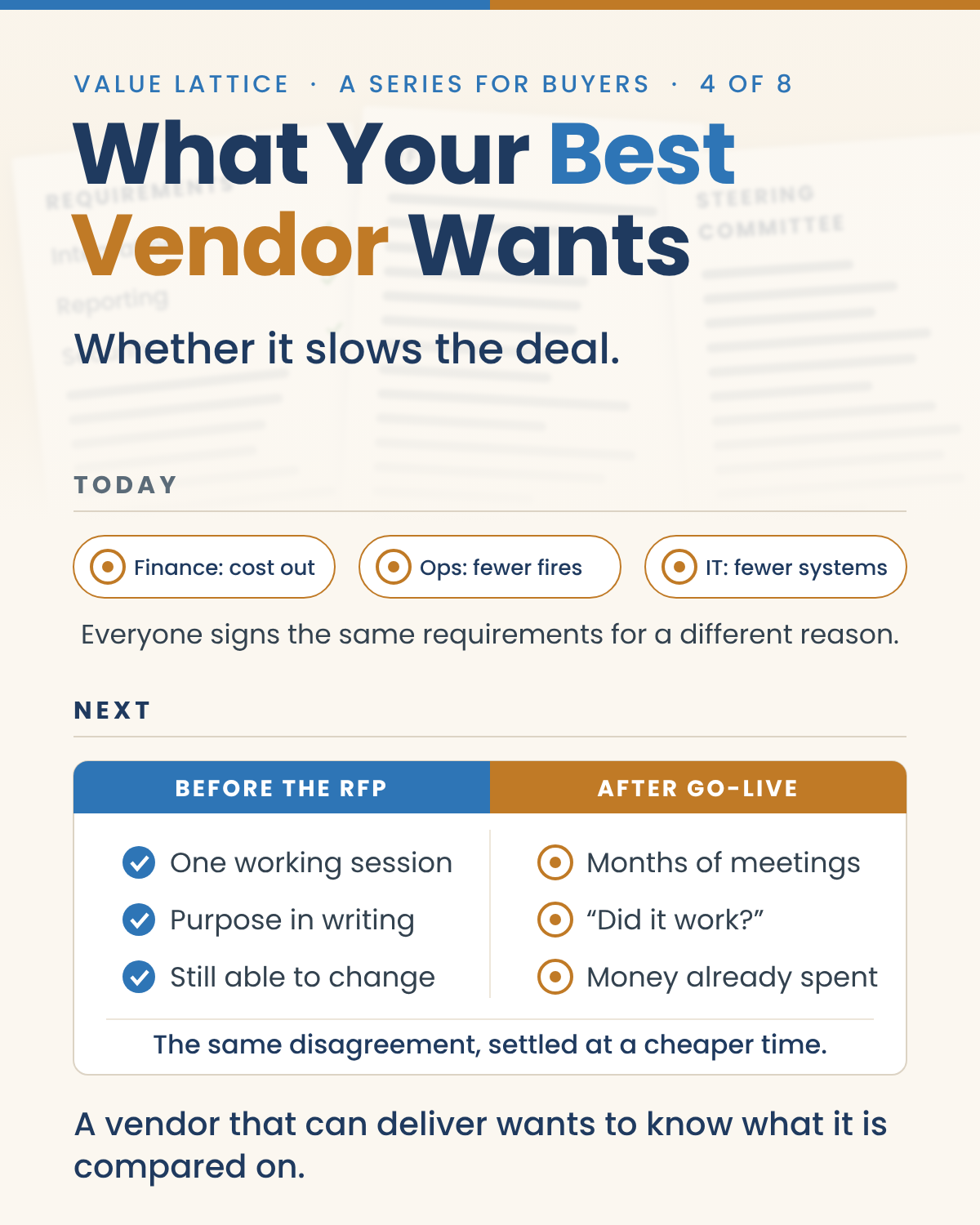
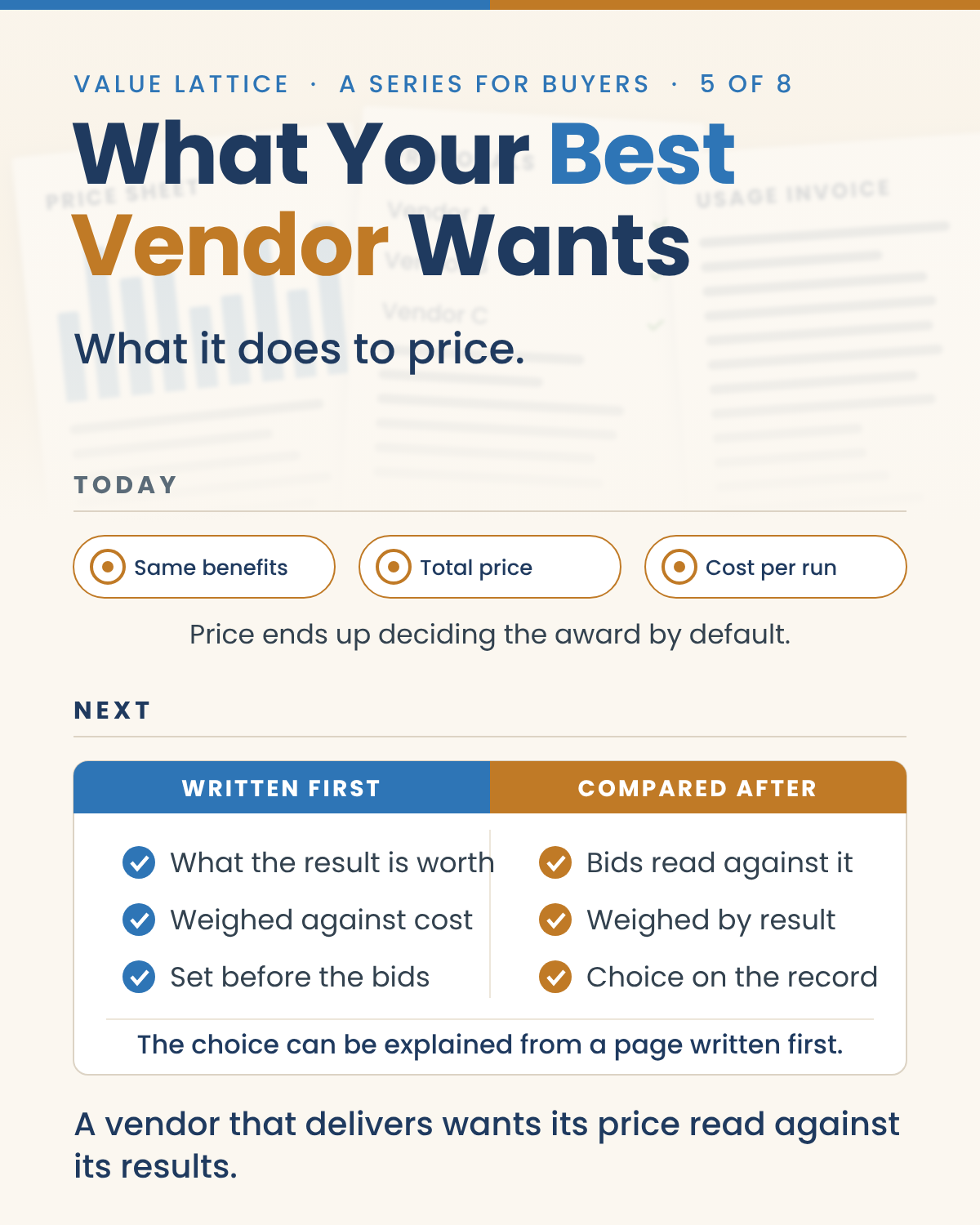
The fourth objection is about price: write the outcome down, and vendors will charge more for it.
Some will try. On the vendor side we priced to whatever the buyer was going to compare, and when the only clean comparison in the room was the total, we fought on the total.
That is what most evaluations come down to. Every proposal promises the same benefits in different words, so price is the one line anyone can lay side by side, and it ends up deciding the award by default. Usage pricing adds another tidy number, the cost per run. That number shows what each use costs. Whether the uses produced what the purchase was approved for is a separate question it doesn’t touch.
The fix is a line written before any price arrives, saying how the result will be weighed against the cost: what a point of churn is worth to the business, for example, or a day taken off the close. With that line in place, the team can pick a higher bid on purpose when it credibly moves the result, and explain the choice from a page written before anyone saw a number.
A vendor with real results gets the most out of this, because its pricing conversation starts from what it delivers.
The comparison basis is one entry on the Request for Value. More on what unit pricing leaves out: https://valuelattice.com/you-chose-the-outcome-the-vendor-still-keeps-the-count/
The last objection comes from my own side of the table. We built the business cases buyers relied on, and a buyer-held record can sound like it makes that work redundant.
I don’t think it does, but it does change what our numbers get checked against.
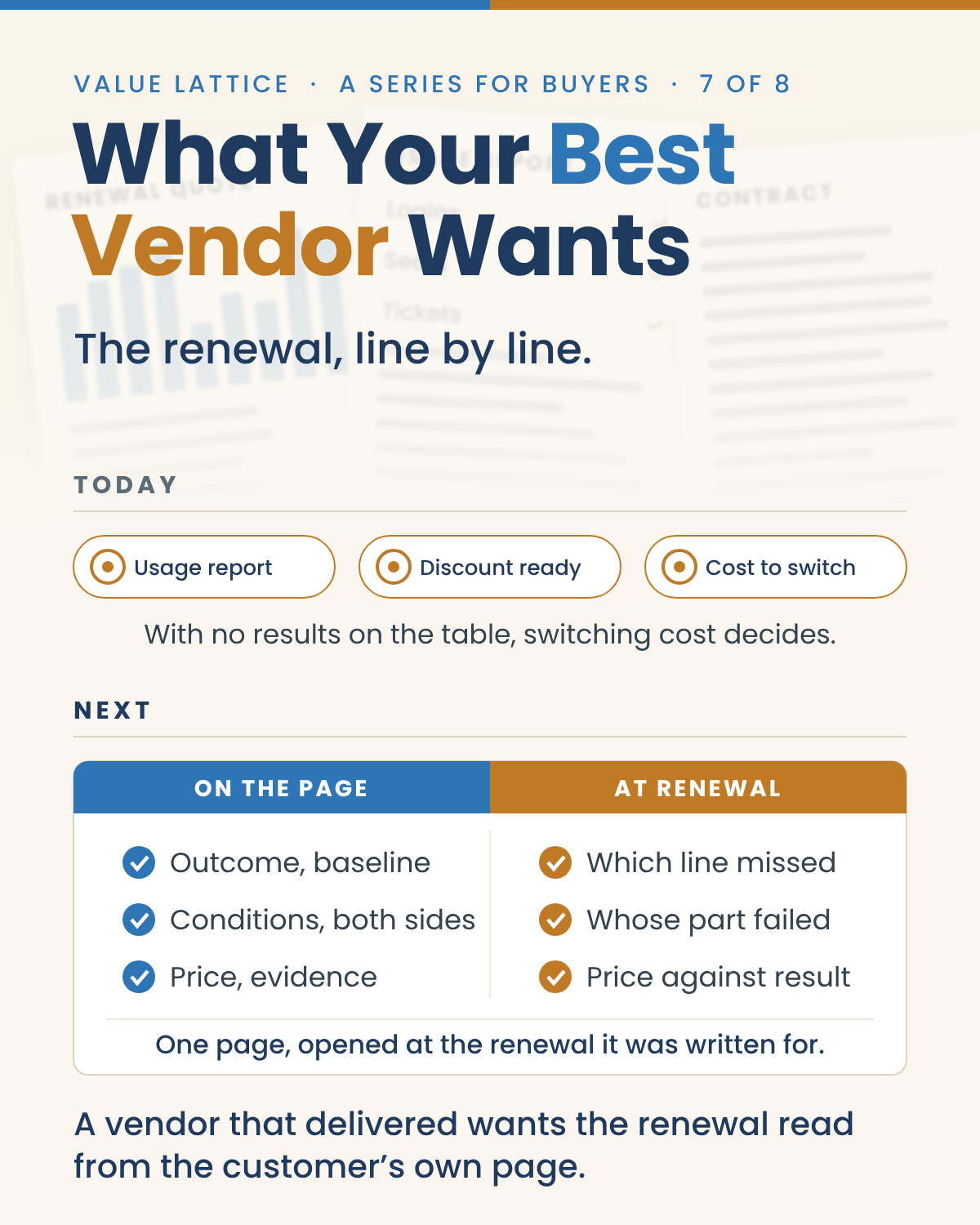
For most of my career, the business case was finished before the sale and rarely opened after it. That has started to change. Some platforms now pay their partners partly on customer outcomes, and those partners run value programs well past go-live, with value plans, templates and progress reporting. I think that’s a good thing.
There is still a gap, though. The side being paid on the result is now the side defining it and counting it, and a finance team will read those reports as the vendor grading itself, however careful they are.
The buyer can close that gap before signing. It decides what evidence will show the value arrived and which of its own systems the evidence will come from: the ledger or the service records. The vendor’s reports then sit beside the buyer’s figures instead of standing in for them.
A vendor that delivers ends up with its result in the customer’s own ledger, which is a better reference than anything we used to write about ourselves.
The evidence line is one entry on the Request for Value. More on vendor-run value programs: https://valuelattice.com/the-vendor-now-runs-value-realization-the-record-still-has-to-be-yours/
A renewal is the first time most buyers ask whether a purchase worked, and often nothing was written down to check.
Over this series I’ve taken on five objections vendors raise when a buyer writes one page, before signing, that says what the purchase is for. The answers added five lines:
• What the purchase has to produce, in the business’s own words
• The starting number, from the buyer’s own records
• What each side has to do for the result to arrive
• How the result will be weighed against the price
• What evidence will show it arrived, and from which system
That page is the Request for Value.
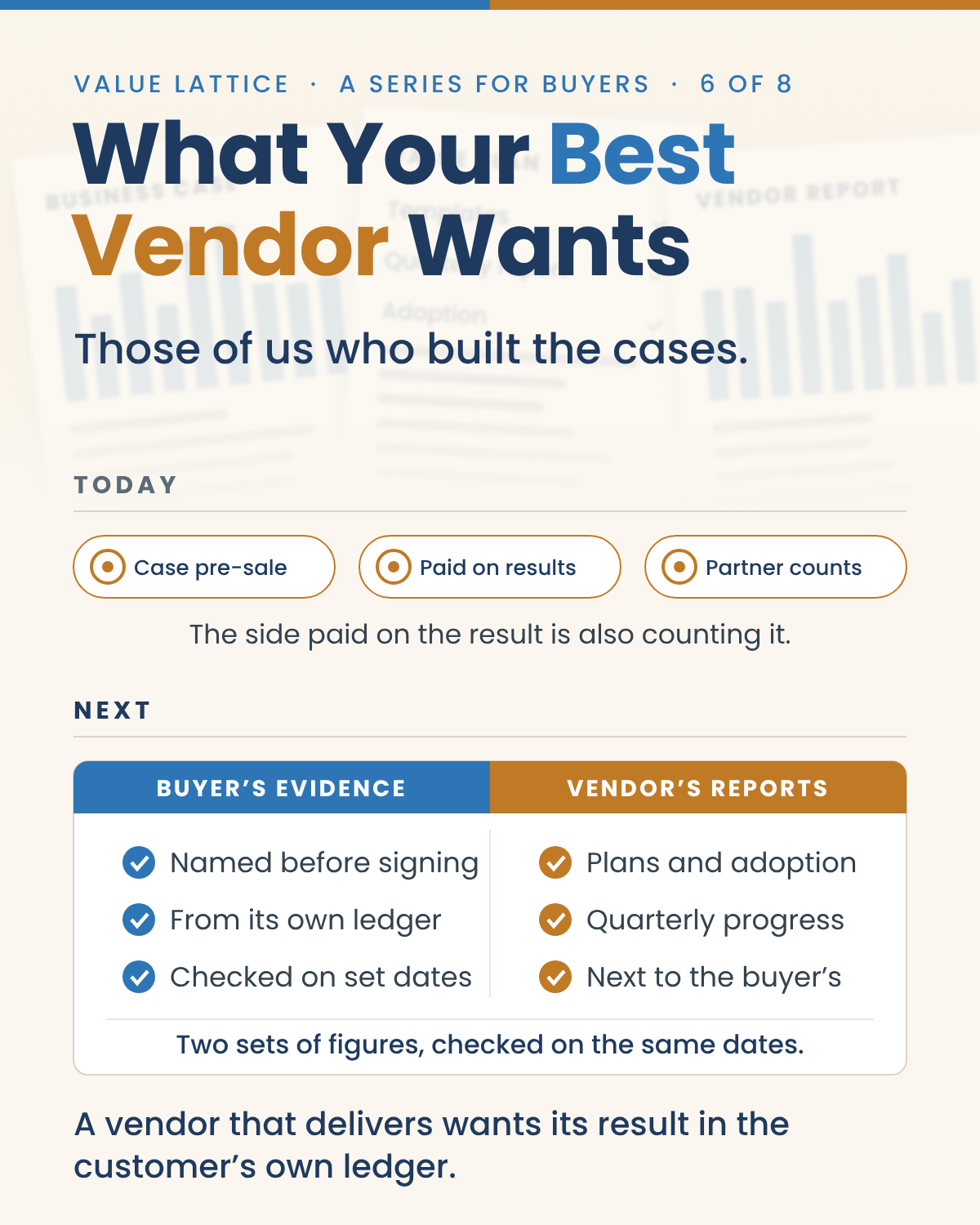
Without it, a renewal runs on whatever’s lying around. On the vendor side, we usually came in with a usage report and a discount ready, and the buyer had the invoices and a good sense of how painful switching would be. Most of the time the contract rolls over, because staying is easier, whether it delivered or not.
With the page, the renewal team can go down it line by line: where the number started and where it is now, which side did its part, and whether the price was worth what came back. If something fell short, you can see where, and if it worked, the proof is in the buyer’s own numbers.
A vendor that delivered walks in with its results already in the customer’s files, so the conversation starts there instead of with a discount.
More on why a review needs the original claims written down: https://valuelattice.com/when-a-purchase-disappoints-the-original-claims-are-missing/
Post 8
Added here on the day it is published.
The page the series is about, the Request for Value, is free to download and adapt on the Guides page.
Sixteen posts, one argument, each closing with a Governance Check to run inside your own organization.
Act I. Recognition
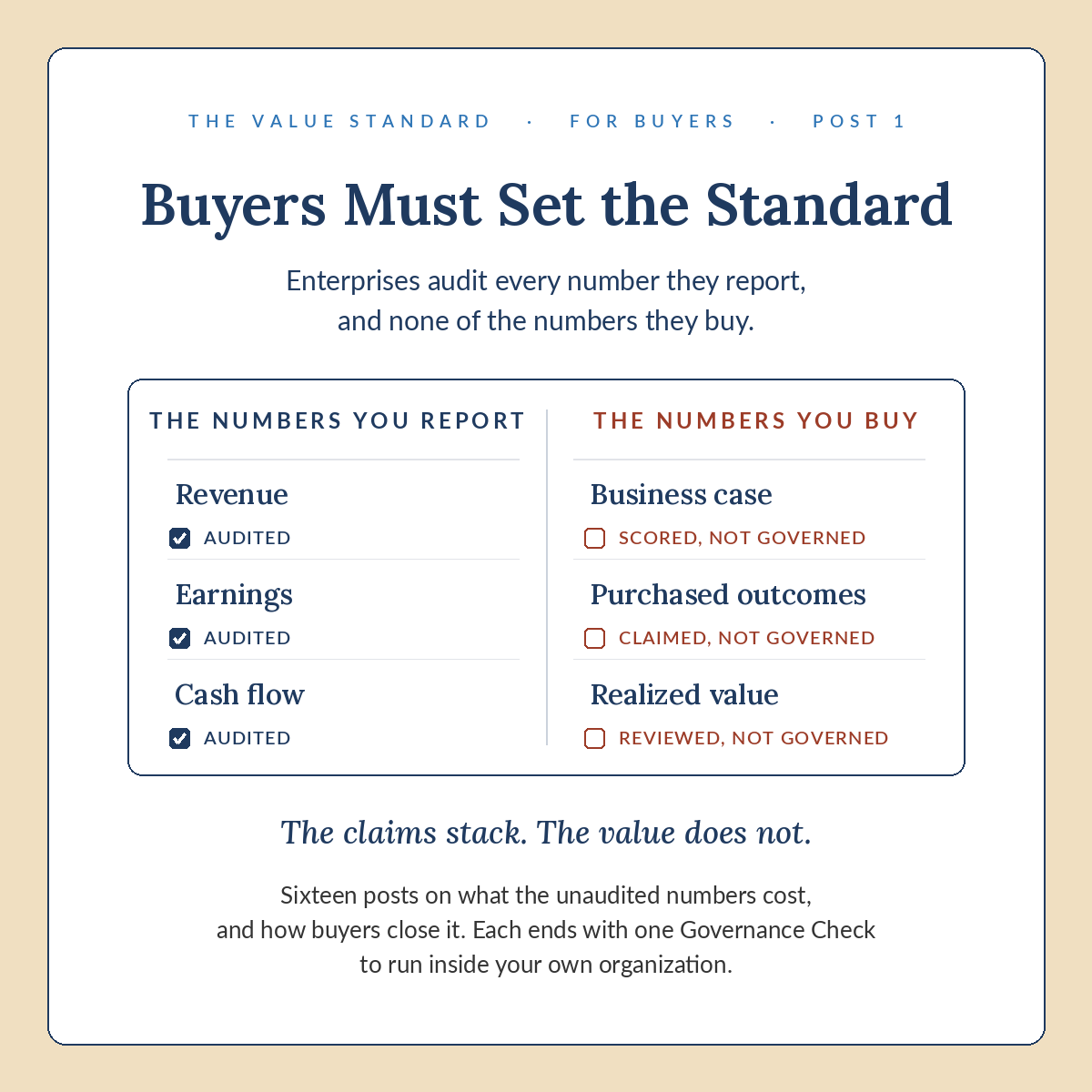
Your company has a rulebook for recognizing a dollar of revenue. It has no rulebook for recognizing a dollar of promised benefit.
The asymmetry repeats down the financial statements, line by line.
Revenue is the enterprise’s opening claim, and because opening claims invite optimism, recognition rules exist. A dollar cannot be booked as revenue until it meets defined criteria. The business case is a purchase’s opening claim. It enters the enterprise with no recognition criteria at all. Approval is the only gate, and approval is a forecast, not a verification.
Earnings are the performance number. They are audited, and the CEO and CFO certify them personally, with liability attached. Purchased outcomes are the purchase’s performance claims: the cycle time cut, the productivity gained, the risk reduced. They are certified by a green status indicator on a steering committee slide, signed by no one. Nowhere in the enterprise is there a signature that says the outcome arrived.
Cash flow is reported because profit is an opinion and cash is a fact. The statement exists to force the story to reconcile with money that actually moved. Realized value is the point where promised value must become fact, and nothing forces that reconciliation. Your company produces a cash flow statement every quarter. It has never produced a value realization statement for its ten largest purchases.
The audited column exists because enterprises long ago stopped trusting their own unverified claims. The numbers they buy are the same three kinds of claim, made by an outside party with a commission attached, and governed by none of that machinery.
You did not choose this arrangement. Confirming whether the value arrived was never assigned to anyone.
Governance Check: who in your organization has the authority to declare that a purchased outcome did not arrive?
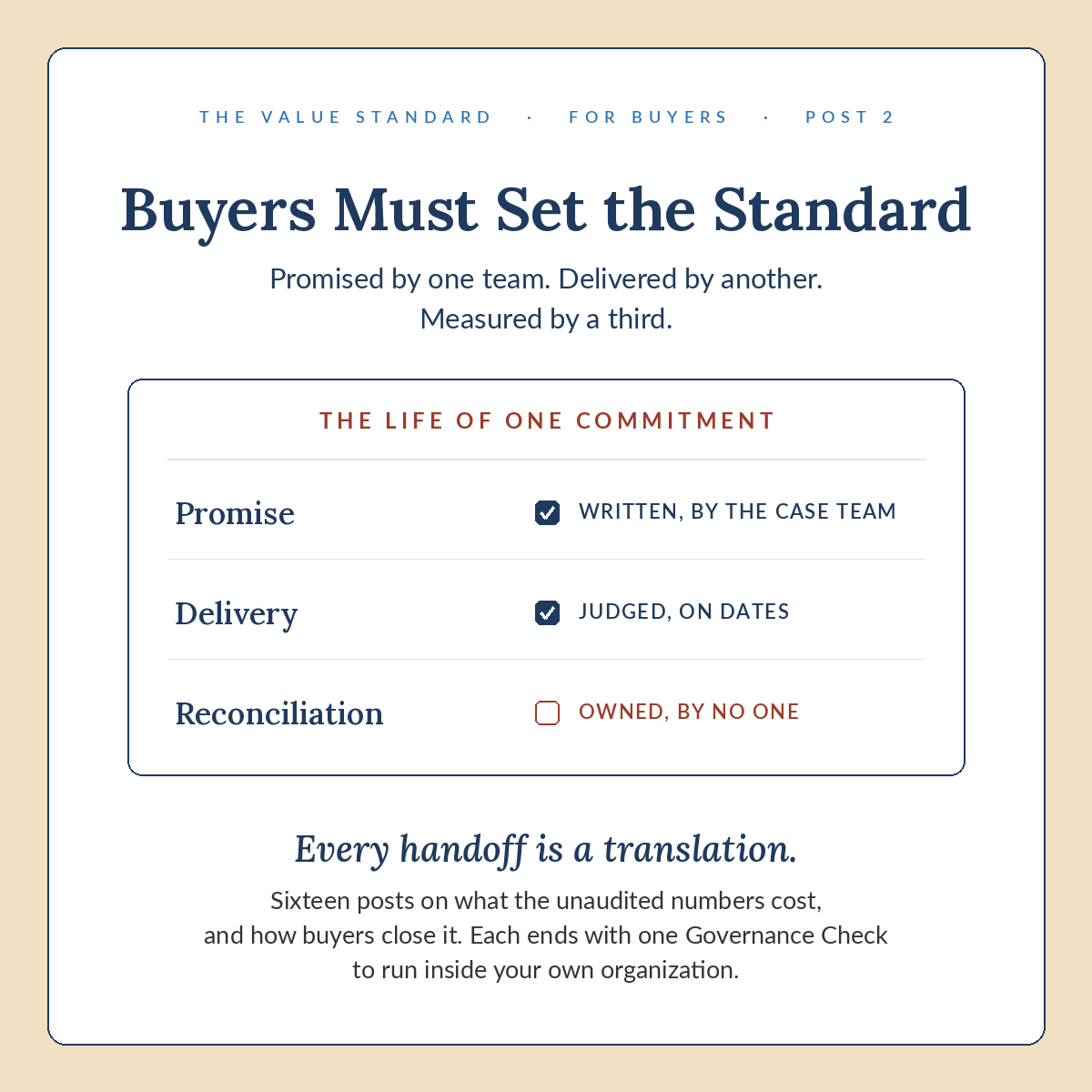
Your last major purchase was promised by one team, delivered by another, and measured by a third.
Consider the mechanism. The team that built the business case owns the promise, then hands it off. The team that implements owns delivery, and delivery is judged on dates. The team that reports owns a number that was available to report rather than the one that was promised. Each handoff is a translation, and each translation is defensible on its own.
At the end of the chain nobody is holding the original commitment. No step in the process places the number from the business case beside the number in the report and requires someone to account for the difference.
That is why the postmortem finds nothing wrong. Every team met its own definition of done.
You did not choose this arrangement either. The promise crossed three desks, and carrying it the whole way was never anyone’s job.
Governance Check: on your last major purchase, who compared the outcome to the number in the approved business case, and what happened to the gap?
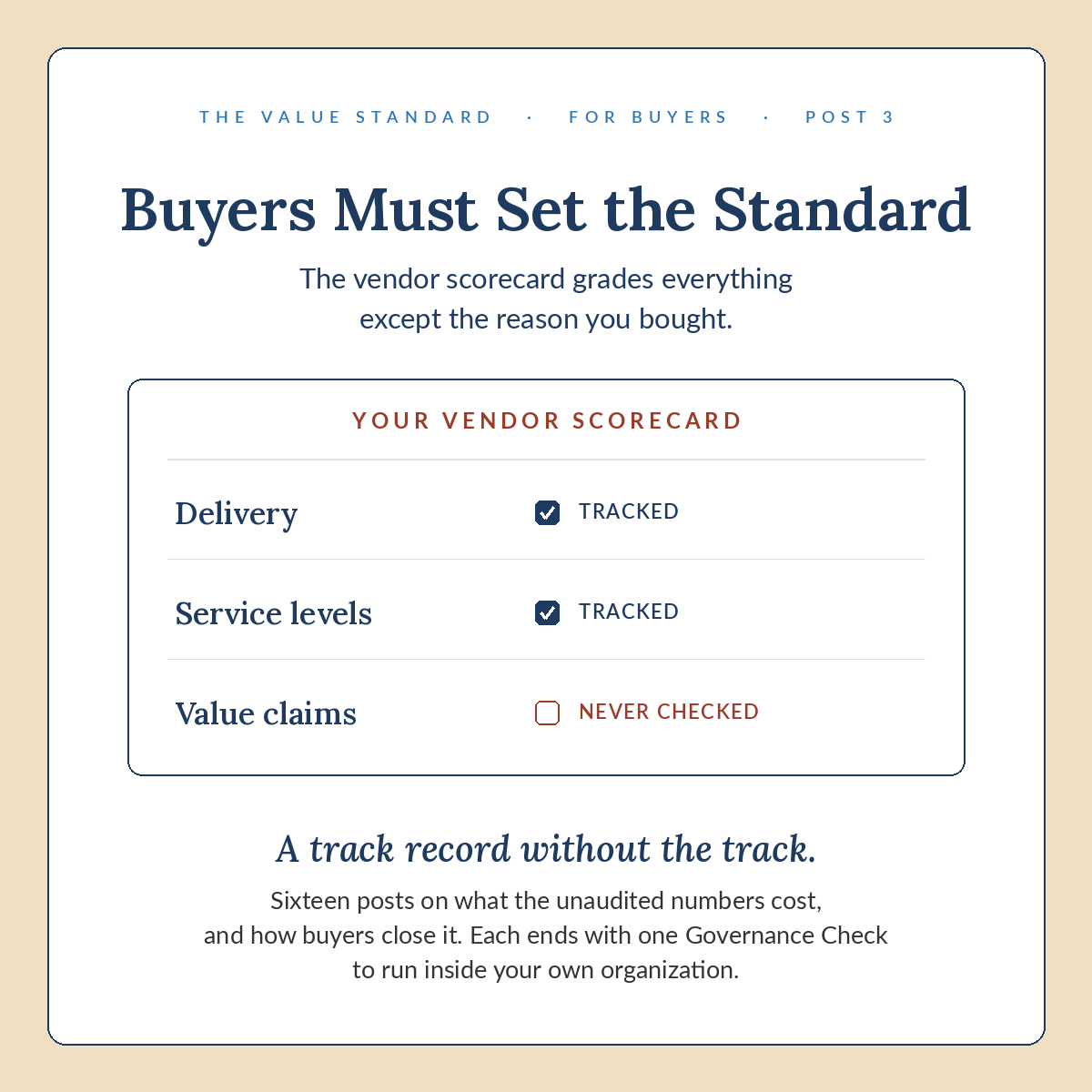
Your vendor scorecard grades everything except the reason you bought.
Look at what it measures. Delivery timelines. Ticket response. Uptime against the SLA. Contract compliance. All real, all worth tracking, and all measures of whether the vendor is easy to do business with. Not one line asks whether the value claims that justified the purchase came true.
Now look at what renewal decisions run on. Relationship. Adoption. Switching cost. The absence of disasters. A vendor can miss every promised outcome and still renew for years, because the misses were never recorded anywhere a renewal decision would find them.
That is how track records work in enterprise buying. A vendor’s record is references, logos, and tenure, without verified claims. The one thing a track record is often missing is the track.
No one built it this way on purpose. Checking claims against results was never assigned to anyone, so the scorecard filled up with what was easy to count.
Governance Check: name a vendor whose last three value claims you have actually checked.
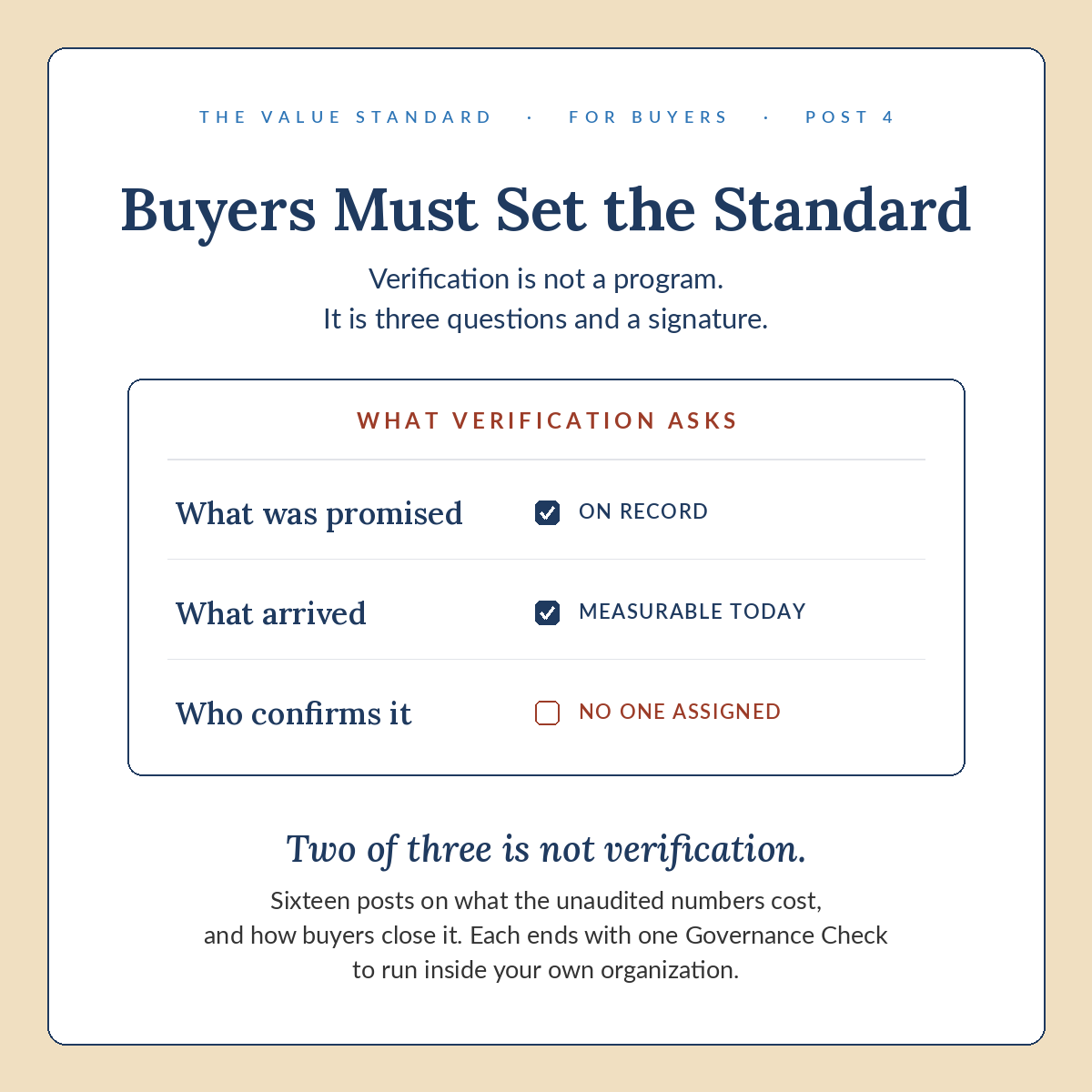
Verification sounds like a program. It is three questions and a signature.
Ask what was promised. Not the vision, the number. The cycle time that was going to drop, the headcount that was going to be redeployed, the revenue that was going to arrive, and the date it was supposed to arrive by. That number exists. Someone wrote it down to get the purchase approved.
Ask what arrived. The same measure, the same period, observed instead of projected. Your organization already produces this data for other purposes. Nothing new has to be built to go look at it.
Ask who confirms it. Not a status color on a slide, not a committee that noted progress. A person whose name sits next to the statement that the promised number did or did not arrive.
Two of those three your organization can answer this quarter with what it already has. The third has no owner, and a question no one is required to answer stops being asked.
That is the whole apparatus. Verification does not need a new function, a new system, or a new vendor. It needs someone accountable for the answer.
Governance Check: on your largest purchase of the last year, can you answer all three before Friday?
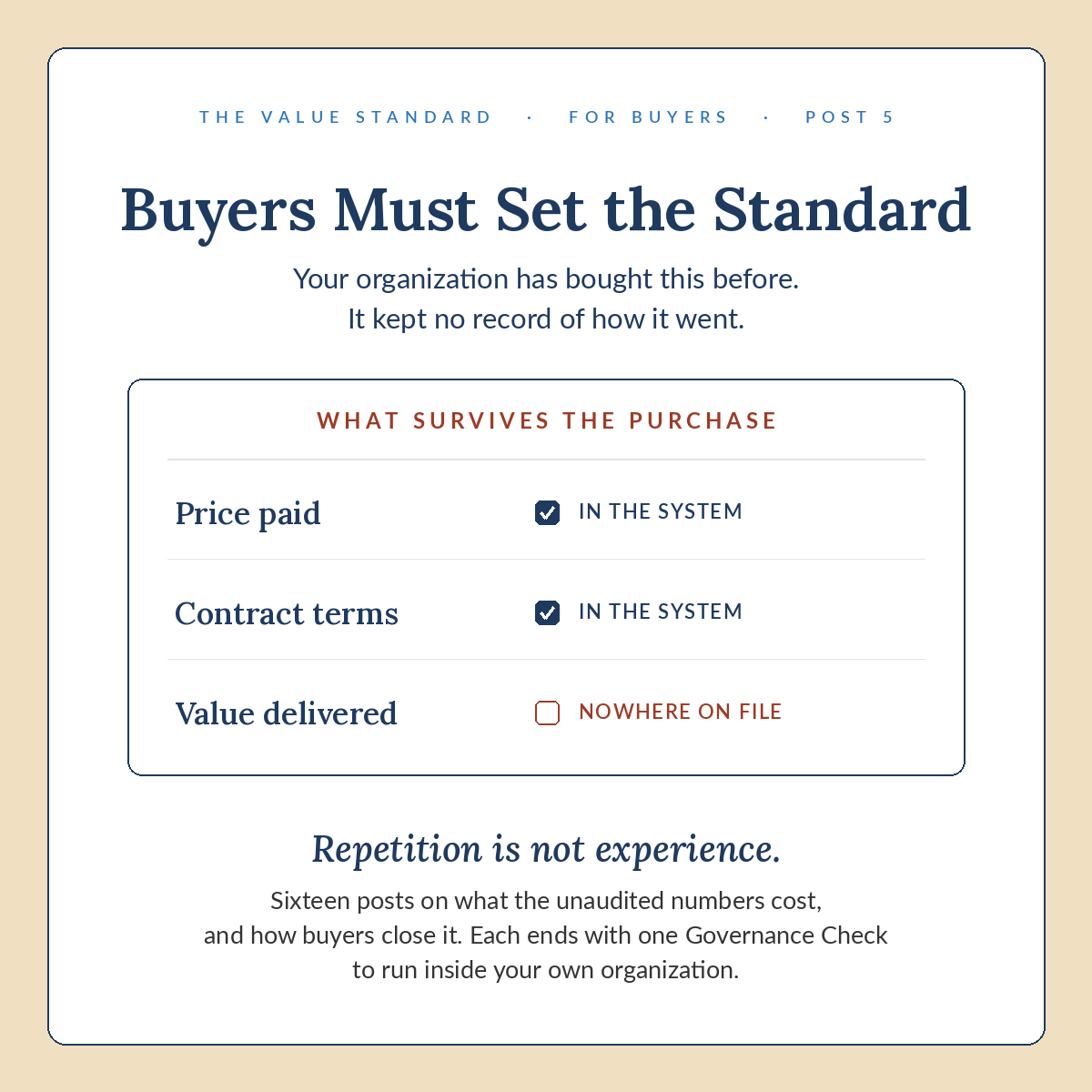
Your organization has bought this kind of thing before. It kept no record of how it went.
Search your systems for the last five purchases in the same category. You will find what you paid, when you signed, what the terms were, and who the vendor was. Procurement keeps that carefully and can produce it in minutes.
Now search for whether the value arrived. There is no field for it. No report returns it. The people who would know have moved to other roles, and what remains is an impression, held by whoever happened to be in the room, that it went well or that it was a mess.
So the tenth purchase in a category gets made with the same information as the first. Not because anyone was careless, but because the one number that would make the next buyer smarter was never written down anywhere that buyer would look.
That is what the unaudited numbers actually cost. Not a single deal that underdelivered. The compounding inability to tell, before you sign, which of your own past decisions worked.
Governance Check: for the last five purchases in your largest category, where would you go to find out which ones delivered?
Act II. Mechanism
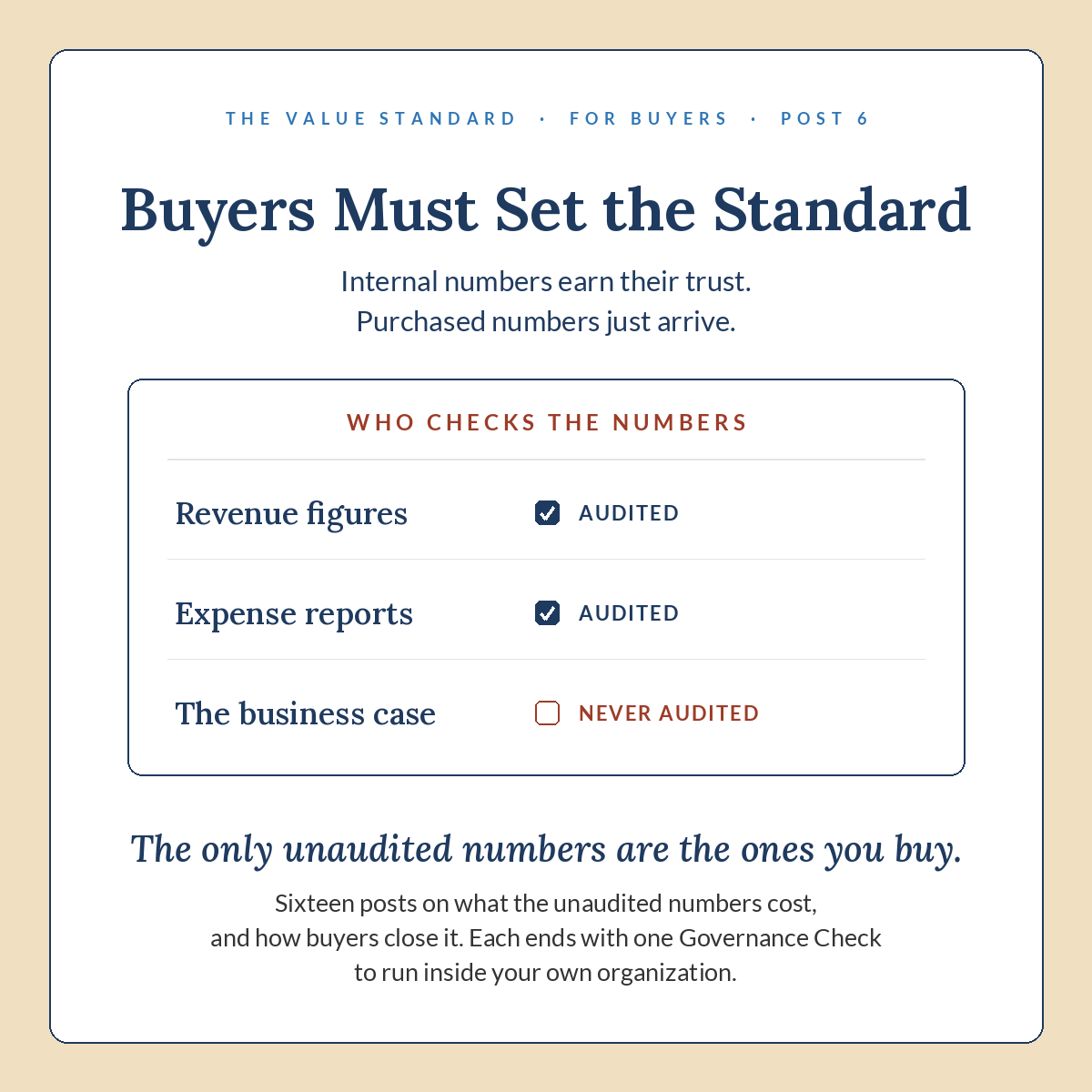
Every number that matters inside your company gets audited, except the ones you buy.
Consider how unevenly the scrutiny falls. Revenue closes under controls that internal audit tests every year. An expense report over fifty dollars gets reconciled. But when a vendor’s business case claims a forty percent efficiency gain, that number typically moves from the pitch deck into your board materials without anyone verifying it along the way.
I call this the audit boundary. Numbers generated inside the organization earn trust through verification. Numbers that arrive from outside are simply accepted, not because anyone decided they should be, but because verifying them was never assigned to anyone.
The result is an inversion few organizations notice: the figures with the least at stake receive the most scrutiny, while the figures justifying seven-figure decisions receive the least.
This is not a seller problem. The vendor’s numbers are doing what they were designed to do, which is to support a purchase decision. Whether they deserve to is a question only the buyer can answer, and in most organizations, no one owns the question.
I wrote about how the boundary works and what closing it looks like: https://valuelattice.com/the-numbers-nobody-audits/
Governance Check: Take your last major purchase. Which claimed number justified it, and who inside your organization verified that number before the money moved?
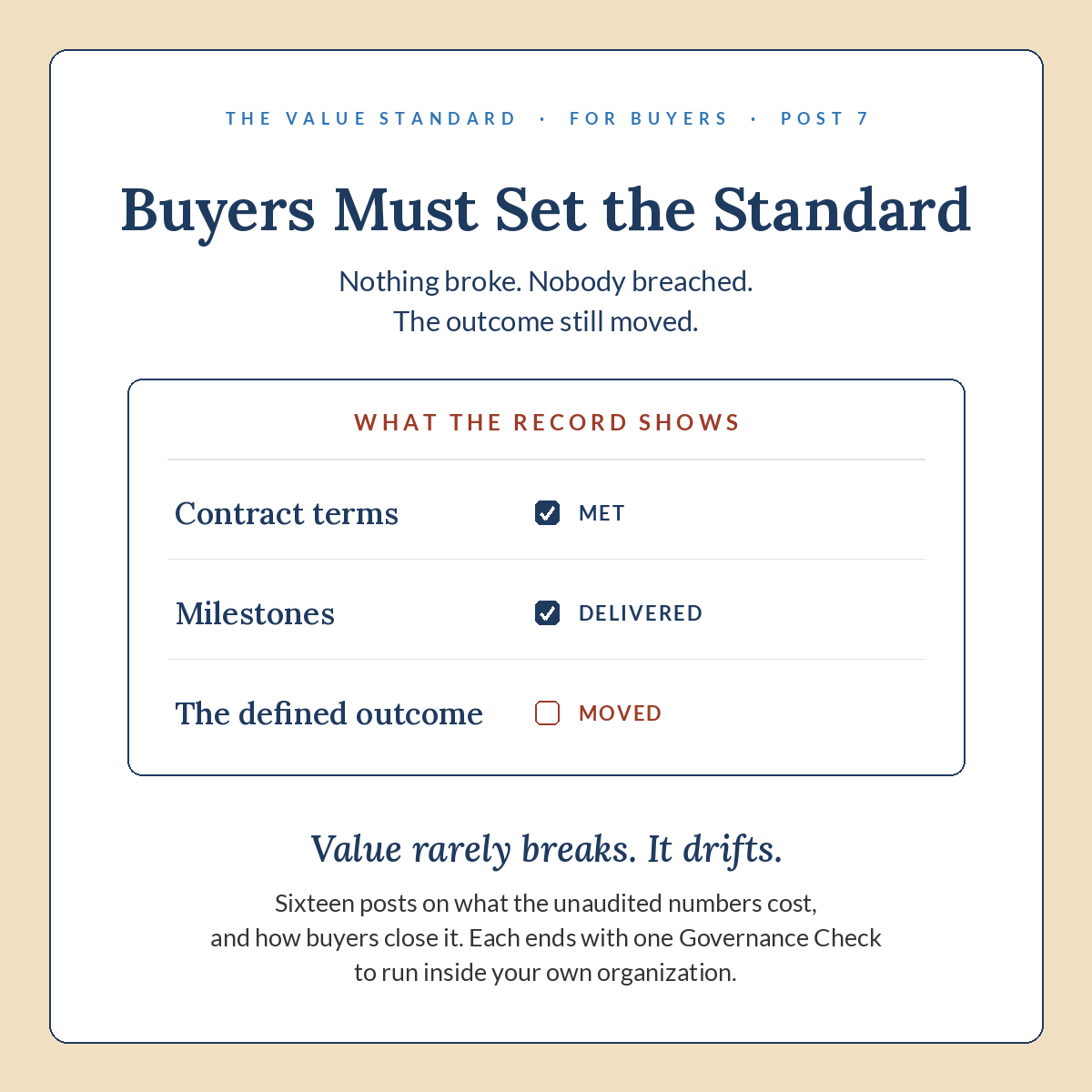
Nothing failed, nobody breached the contract, and the value still did not arrive.
This is the pattern that confounds organizations most, because there is no failure point to find. The vendor delivered what the agreement specified. Every milestone cleared review. And the outcome the business case promised quietly stopped being the outcome anyone was tracking.
In the book I call this value drift, and it works through three mechanisms. Interpretation means the definition gets re-read to fit what is already happening. Substitution means a measurable proxy replaces the outcome that was harder to measure, so the organization tracks what is convenient rather than what it committed to. Relaxation means the standard softens a little each quarter, because holding it would require a difficult conversation.
Each adjustment is small and defensible in the meeting where it happens. Compounded across a year, they can relocate the entire value of a purchase without triggering a single alarm.
Drift is not vendor behavior. It is what happens to any definition nobody owns, which means the question is never whether your definitions are drifting. The question is whether anyone would notice.
I wrote about what drift looks like when nothing visibly breaks: https://valuelattice.com/nothing-broke-the-outcome-still-moved/
Governance Check: Pick one outcome your organization bought this year. Is it still measured against the definition in the original business case, or against what that definition became?
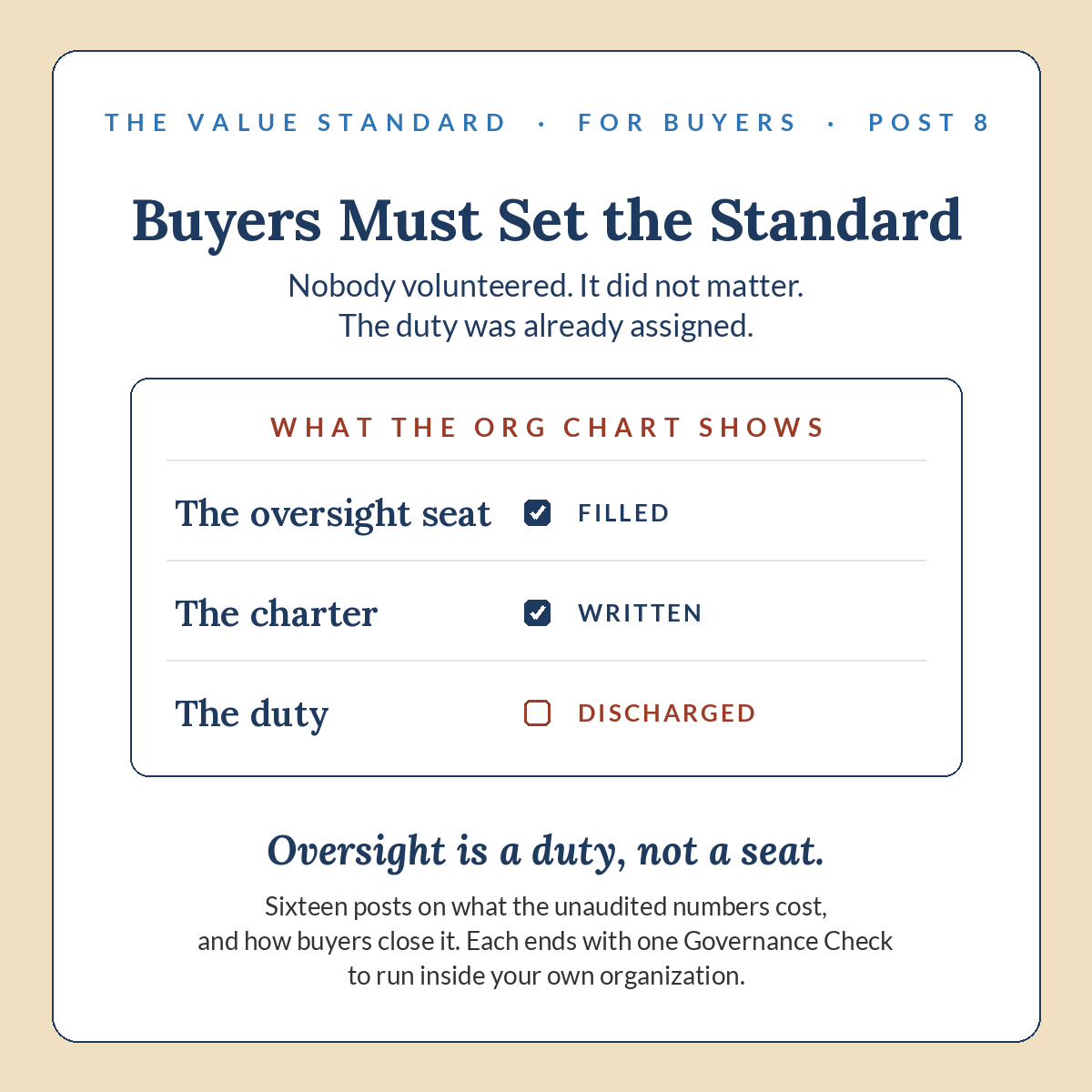
The search for someone willing to own value governance usually ends the way it began: with a name in a box and nothing overseen.
That is because ownership gets treated as a seat, something a person accepts and carries. The duty does not work that way. For the numbers a company certifies, oversight was assigned in advance, by law, to named roles that cannot hand it back. Nobody volunteered, and it did not matter. The only open question is how the duty gets discharged.
In the book I describe the structure that discharges it as the Buyer Governance Pyramid, three layers working as one system. Outcome governance asks whether the results the organization intended are showing up, on a business cadence. Execution governance asks whether the work is proceeding to plan, on a delivery cadence. Decision governance asks whether the hundreds of small choices underneath are still aligned with the commitment, as they are made. When one layer runs alone, value breaks. When the layers run together, value is sustained.
A person cannot be the pyramid. A title satisfies the org chart and leaves the duty undischarged, because a duty this size is met by evidence that oversight happened, not by willingness.
I wrote about where the duty actually comes from and why waiting for a volunteer is itself the breach: https://valuelattice.com/oversight-is-a-duty-not-a-seat/
Governance Check: Name which of the three layers your organization actually runs. If the answer is one committee that meets quarterly, you are holding one third of a pyramid.
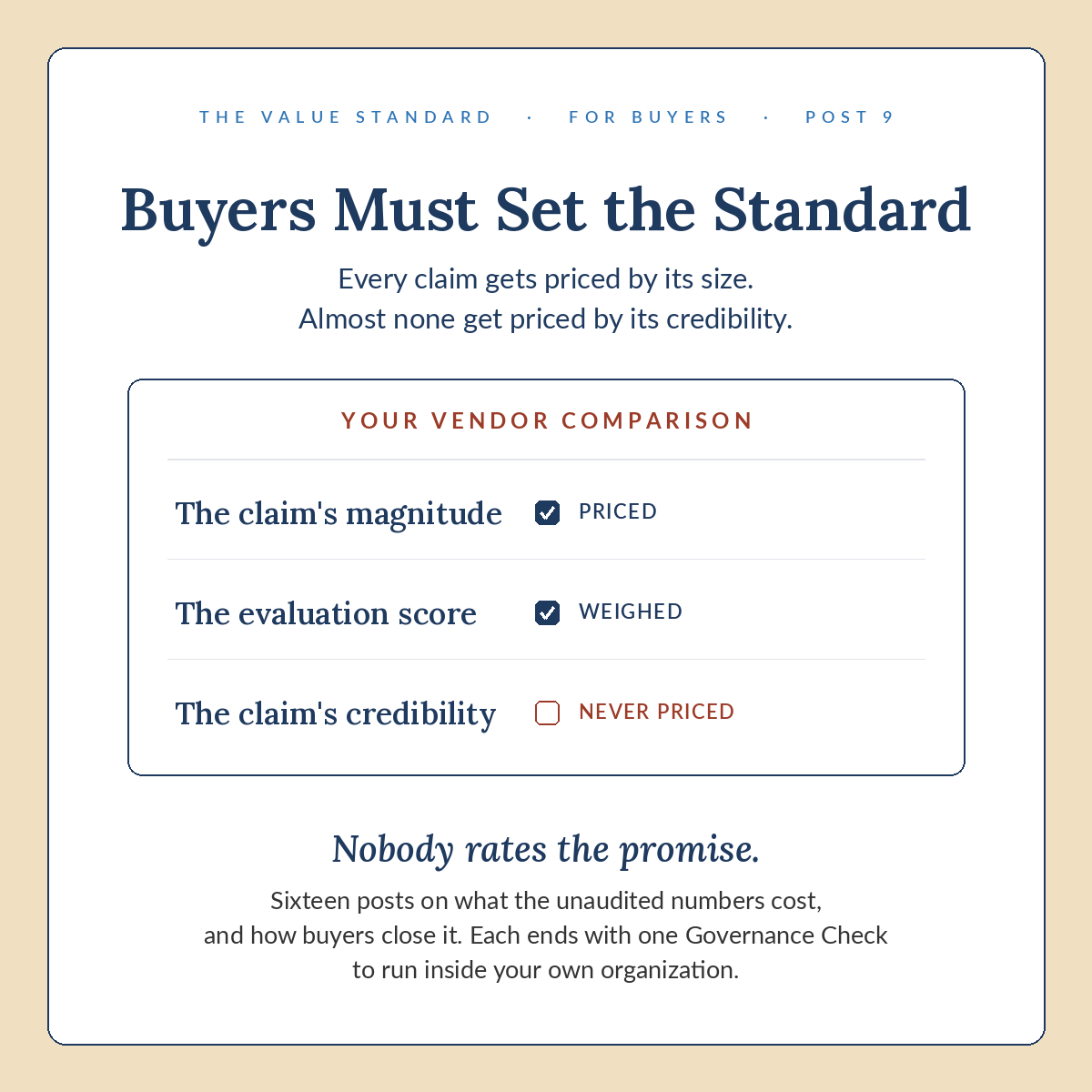
A corporation that promises to repay a billion dollars gets priced on how likely it is to keep the promise. A vendor that promises a 40 percent improvement gets priced on the size of the number.
That is the comparison enterprise buying actually runs. Somewhere on the seller’s side of the table is a team whose whole job is to build the promise. Nobody on either side is scored on whether it came true. So claims get weighed by ambition, and the vendor with the strong record and the honest number loses to the vendor with the large one.
In the book I call this the missing credibility market. Expected value is magnitude times credibility, and buyers can only observe the first term, because it is printed on the slide. Treat the second term as equal across vendors, which is what an evaluation does by default, and the largest claim wins by arithmetic.
No market is coming to fix this. The evidence lives with you: your organization already knows what its purchases delivered against what they projected. It is just unrecorded. Recording it takes a number, a date, and a definition for every claim that enters evaluation, checked on the date, attached to the vendor. The book gives that recording instrument a name, the Request for Value (RFV). Run it for three years and a vendor with a strong record can promise less and win, which is the incentive change that matters.
I wrote about the rating that does not exist and how a single buyer can build its own: https://valuelattice.com/nobody-rates-the-promise/
Governance Check: Take the largest claim in any active evaluation. Can anyone name the vendor’s realization rate on that same claim for its last three customers? If not, the comparison is pricing magnitude alone.
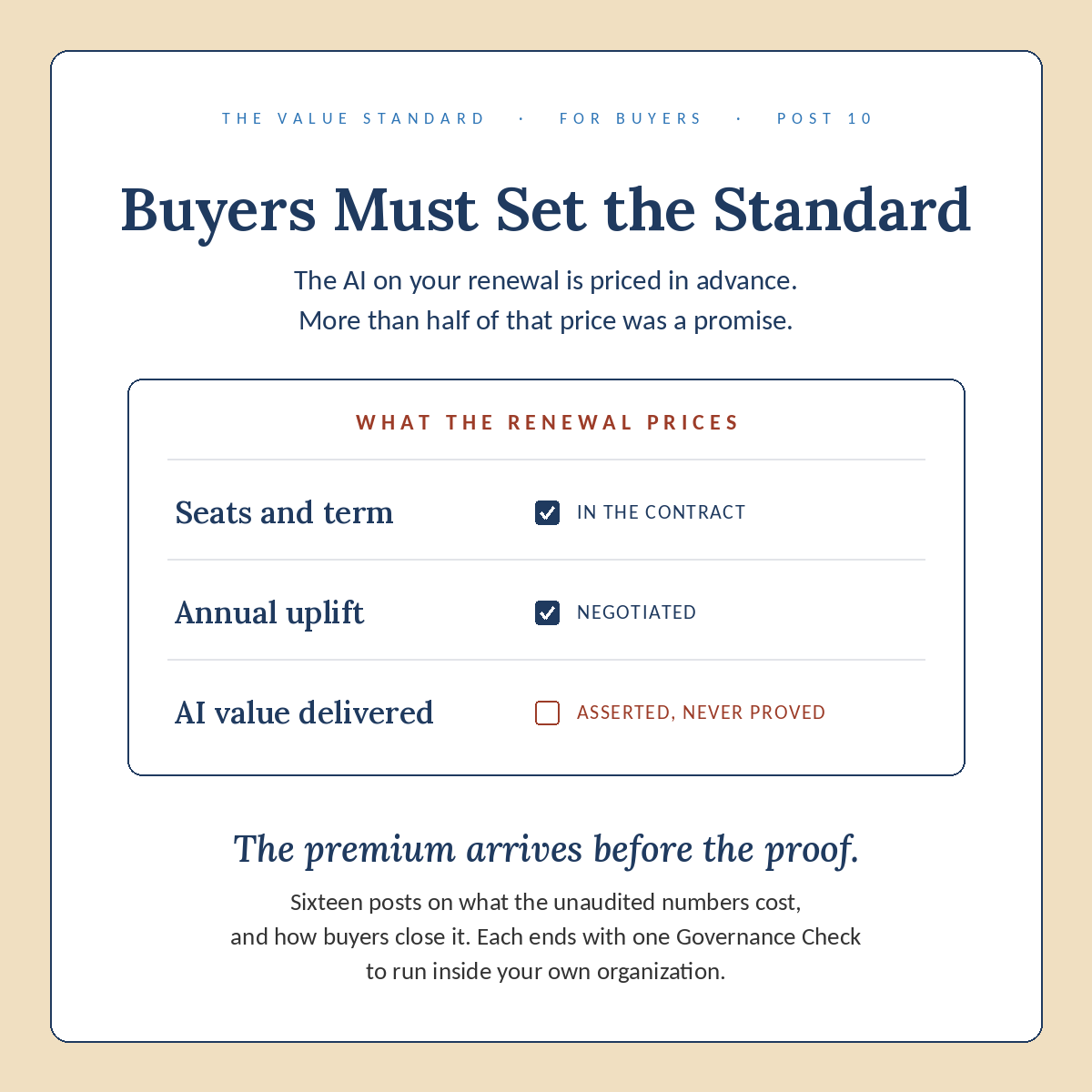
Your next software renewal will charge for AI before anyone has shown what the AI did for you.
Procurement analysts call it the AI tax. Renewals data from Tropic puts the uplift at twenty to thirty-seven percent, against a normal annual increase of three to nine percent. The AI shows up on the invoice whether the seat uses it or not, and the premium is booked the day the renewal signs, on the vendor’s word that the value is there.
The same dataset carries the tell. When a buyer negotiates with structure, the ask drops by roughly fifty-five percent, and the uplift that survives scrutiny averages about twelve percent. The opening ask was built by the side of the table that gets paid on it, from assumptions the other side never inspected. A price that loses more than half of itself the moment someone pushes back was carrying a promise, and a buyer who signs without asking for proof has agreed to fund that promise out of its own budget.
In the book I describe how assumptions compound, each purchase justified by the projected result of the one before it and none of the projections checked. AI has become the amplifier, and the AI tax is that compounding moved onto the price line: last year’s value assumed, next year’s charged in advance.
A buyer who shows up with its own usage data sets the price of proof: what the AI has to demonstrate, which outcome counts as evidence, and when payment attaches to value received rather than value asserted. Without that data the renewal is a bill, and the promise gets paid in full.
I wrote about where the fifty-five percent came from and what pricing AI on proof looks like: https://valuelattice.com/the-ai-tax-is-a-price-on-promise/
Governance Check: Take your largest renewal this year. What evidence did the AI premium have to meet before it was paid, and who inside your organization held it to that evidence?
Act III. Governance
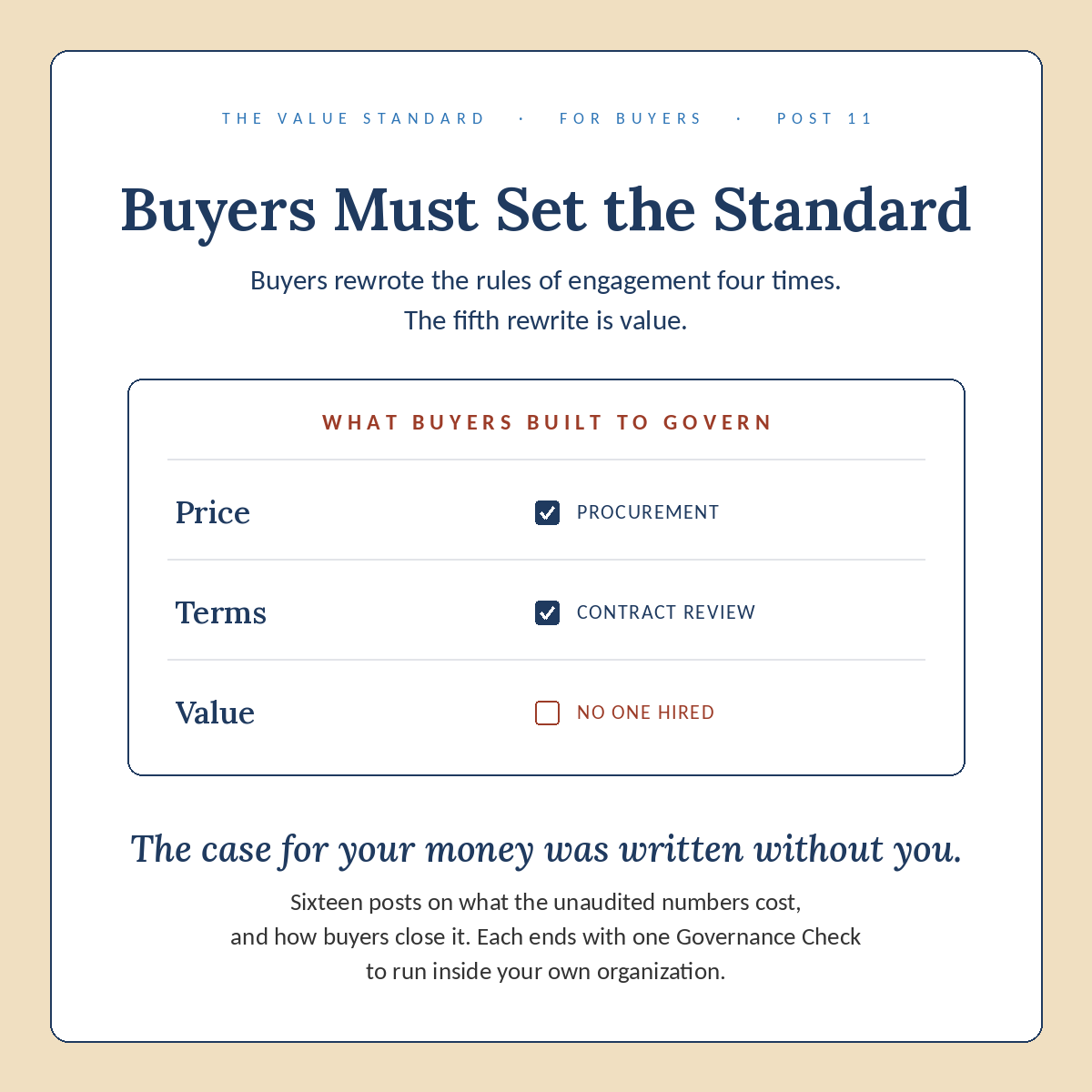
Buyers have rewritten the rules of engagement with vendors four times, and each time it felt like a violation until it became the table.
Procurement came first, once price needed governing. Contract review followed for terms. Security and privacy review arrived for data, over objections that it would slow everything down, and AI review boards are forming right now on the same reluctant schedule. Every one of those functions was an uncomfortable departure from established engagement when it started. Today they are simply how buying works.
One function never got built. Nobody on the buyer’s side was ever hired to define, measure, and govern the value the purchase was supposed to produce. In the book I put the question directly: who controls value engagement? The party that controls an outcome determines whether it is realized, and control here means the authority to define what matters, measure what is delivered, and adjust when drift begins.
Many buyers will say they already measure value realization. The question is what the measurement is anchored to. Effectiveness, efficiency, productivity, competency, readiness: real metrics, every one of them, and not one is the stated objective that led to the commitment and the contract. That is substitution, the drift mechanism from earlier in this series, running inside the measurement program itself. Vocabulary hides it. Buyer and seller use the same words for value and mean different things, and functions inside the same buyer organization do it to each other again.
That authority did not sit vacant. A profession grew into it, on the seller’s side, over twenty years. It is called business value engineering, and much of its work is careful and deep. It is also funded to enable the sale, and a team that gets paid when the deal closes has to believe in the case it wrote. Checking that case takes a different posture, and it has to sit with someone the sale does not fund.
Owning value governance is not a departure from the established system so much as the fifth run of a pattern buyers already trust, three of them settled, the fourth underway, none remembered as a violation. The rules of engagement are whatever buyers built when necessity arrived.
I wrote about the profession that has been writing the case for your money, and why you have never met it: https://valuelattice.com/the-case-for-your-purchase-was-written-without-you/
Governance Check: Pull one number your organization reports as value realized. Is it scored against the stated objective that led to the commitment and the contract, or against a metric that was easier to keep?
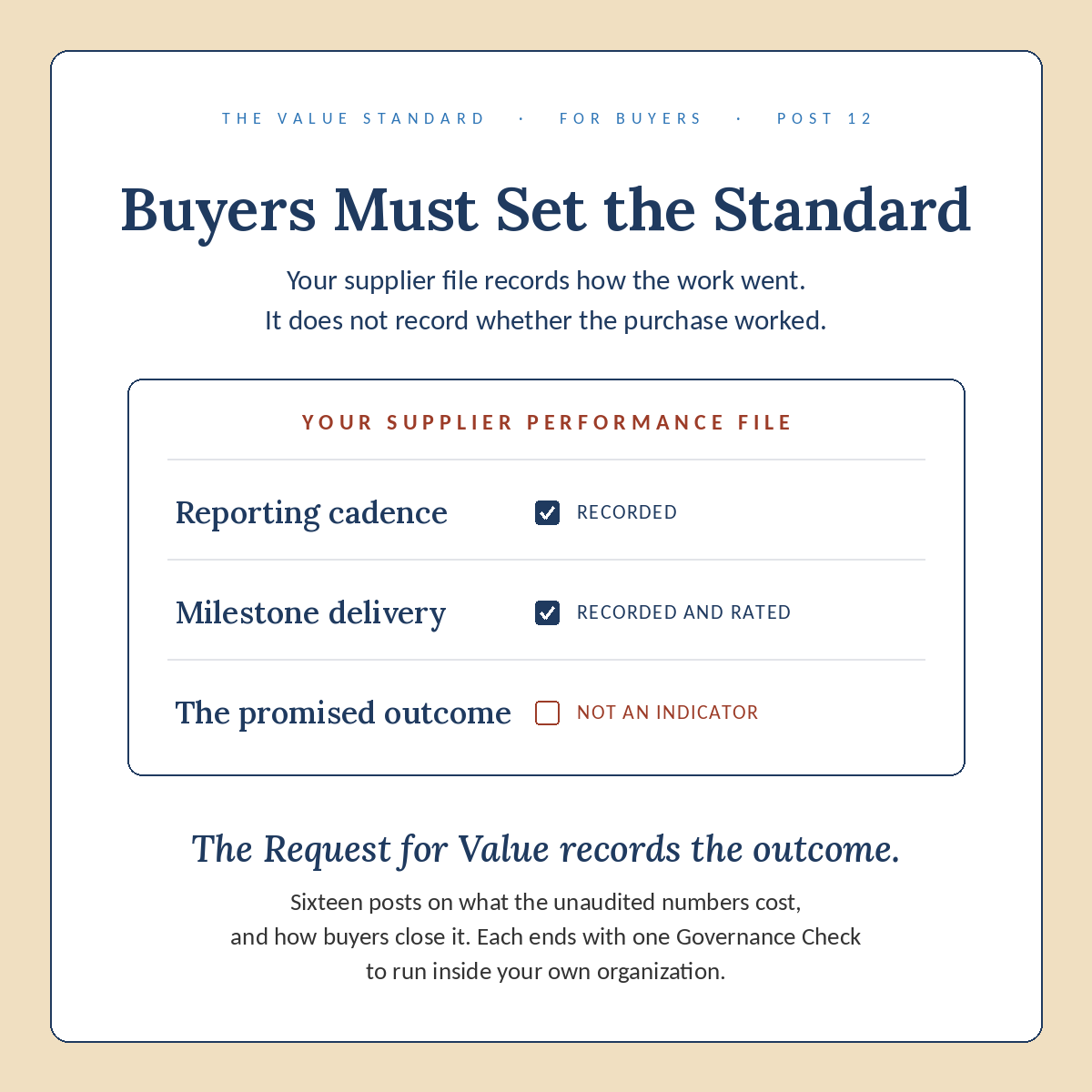
Britain now requires public buyers to publish a verdict on their suppliers. The statute never says the verdict has to measure the outcome.
The regime sets performance indicators on large public contracts and publishes the annual assessments, where a rating follows a supplier into its next negotiation. Nothing in it requires any indicator to name the thing the contract existed to produce. A supplier can be rated green on reporting frequency and milestone delivery while the outcome that justified the spend never arrived.
That is the failure mode of most value records I have seen inside buying organizations. I built a fair number of them earlier in my career, from the other side of the table. The record exists. It measures whatever was easiest to observe.
In the book the instrument that closes this is the Request for Value, and it is a document the buyer writes before vendors are contacted. For every claim that will enter the evaluation it carries a number, a definition of what counts, the date the claim comes due, and the name of the person who checks it on that date. Vendors answer the RFV. They never author it.
One clause does most of the work. At least one recorded claim has to name the outcome the purchase exists to produce, in language a finance reviewer would recognize, with the evidence identified before signature and kept in your files rather than the supplier’s.
Three years of those checks is a track record you own, on claims you defined, covering vendors nobody else is scoring.
I wrote about what Britain’s regime records and what it leaves out: https://valuelattice.com/britain-made-buyers-publish-a-verdict-on-their-suppliers/
Governance Check: Open the supplier performance file for the largest contract you signed last year. Does a single indicator in it name the outcome the contract existed to produce, or do they all measure how the work was administered?
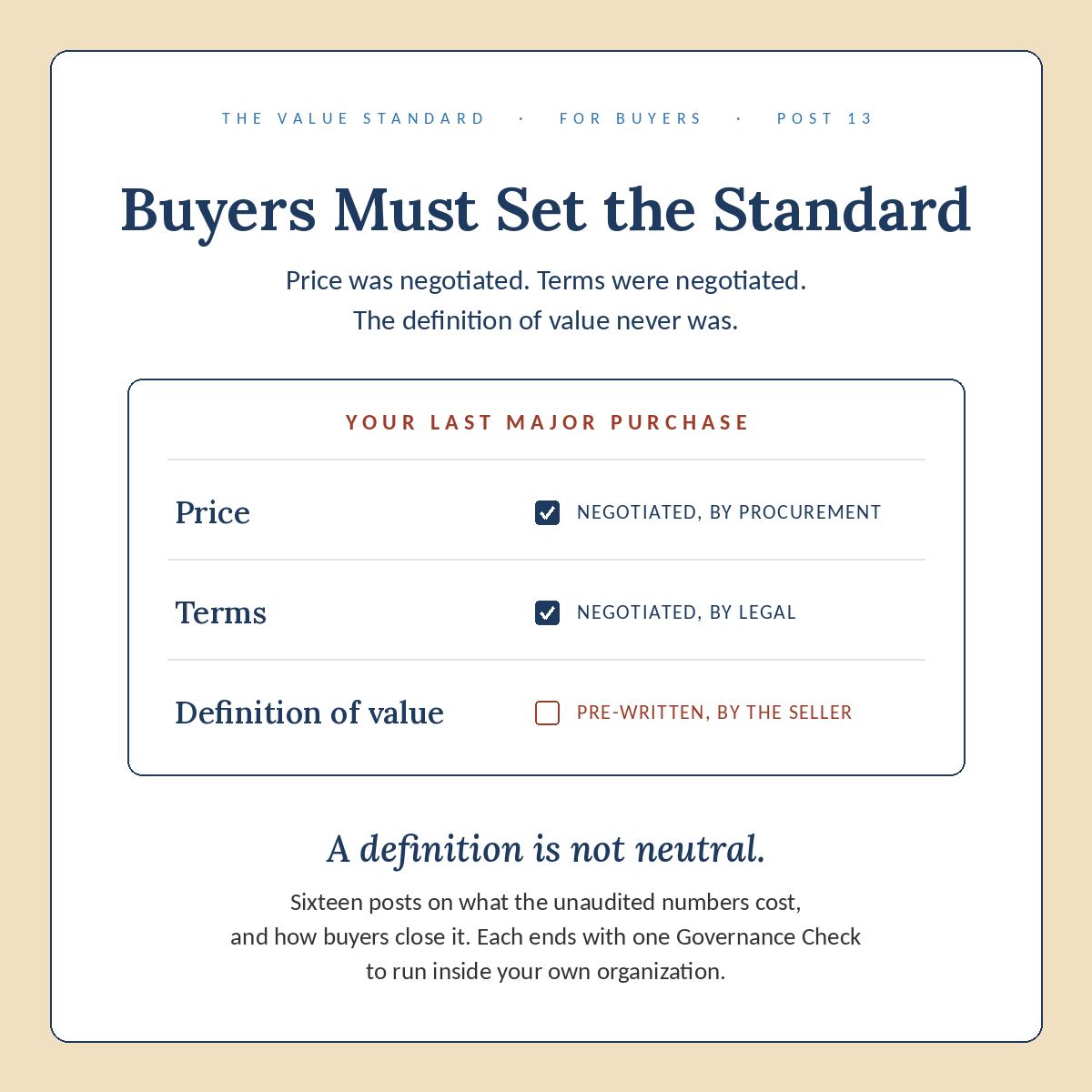
On your last major purchase, everything was negotiated except the one thing that decided whether it worked.
The ROI model arrived from the vendor’s value calculator, its baseline set in the vendor’s discovery workshop and its savings targets drawn from the vendor’s benchmark library. Your team reviewed those numbers, adjusted a few assumptions, and pushed hard on price. What counts as value, how it is measured, and when it can be declared achieved was never an item on the list.
That is the quiet asymmetry in enterprise buying. Procurement brings real discipline to price and legal brings it to terms. The definition of value gets no negotiator at all, because it arrives pre-written inside the seller’s template, where it reads like arithmetic instead of authorship.
A definition is not neutral. Whoever writes it decides what gets counted and what gets left out, and what the word achieved will mean when someone finally uses it. If value is declared against the seller’s definition, the outcome was chosen when the template was.
Nobody decided it should work this way. It settled in one template at a time, and a template arrives with the definition already filled in, which is why the choice never looks like a choice.
I wrote about writing that definition before the tool arrives, and holding every tool to it afterward: https://valuelattice.com/the-buyer-sets-the-definition/
Governance Check: Find the approved business case for your largest purchase this year and read the part that defines success. Did anyone on your side write it, or did it arrive already written?
Most purchases are governed hardest during the months when nothing they were bought for can happen yet.
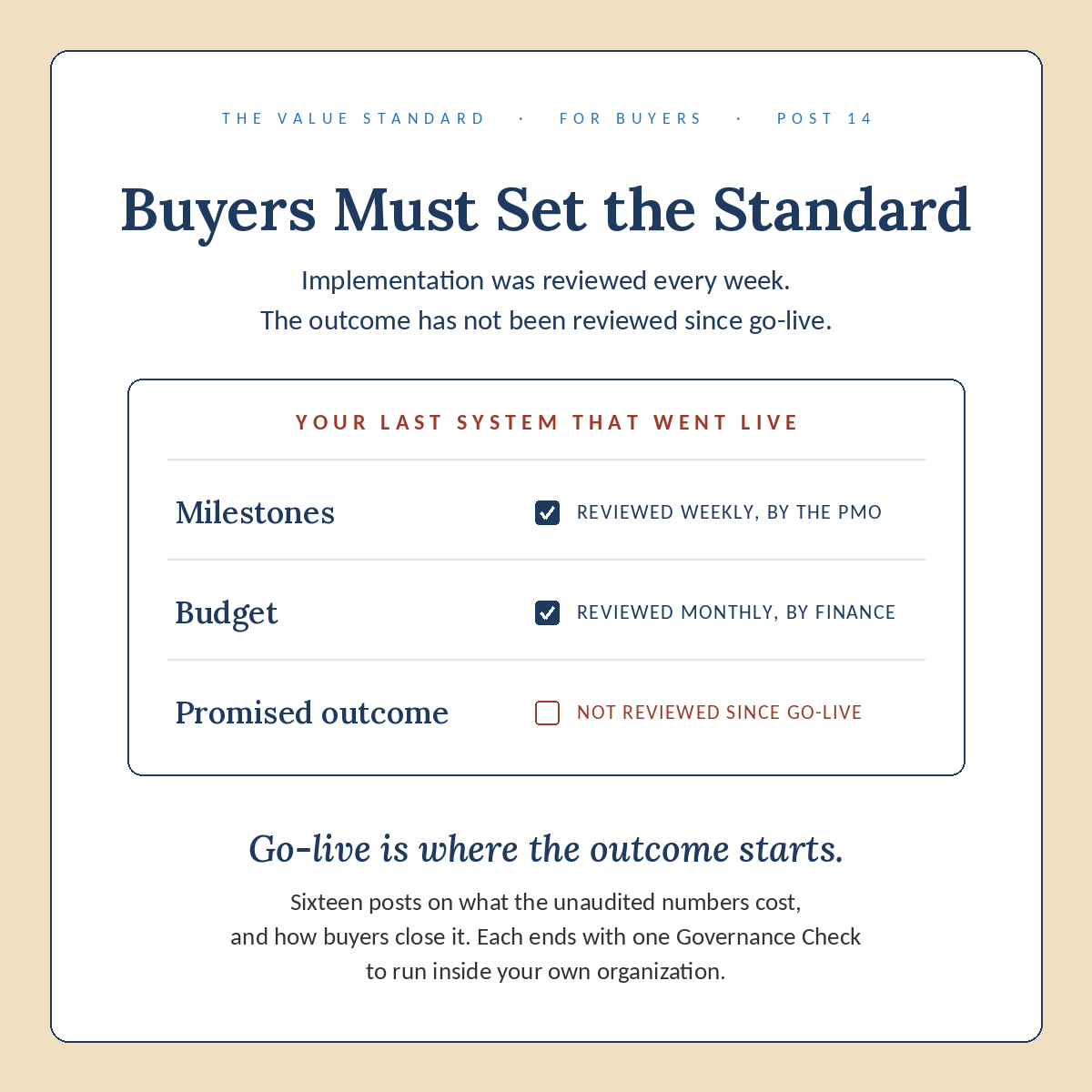
Through implementation the steering committee meets every week. Milestones are tracked, risks are logged, the go-live date gets defended in every status report. Then the system goes live, the project closes, and the people who watched it move on. The outcome in the business case starts arriving, or not, at about the time the watching ends.
The gap has a shape. Implementation gets a cadence because it has dates. Value has no dates, only a number written at approval, so it inherits whatever oversight is left over, which is often the vendor’s own quarterly review on the vendor’s own dashboard.
Another committee will not close it. The evaluation metrics have to stay in the room after the contract is signed: the outcomes, measures and conditions that justified the decision, reviewed weekly for execution, monthly for outcome, and quarterly against the strategy the purchase was meant to serve. Anyone who changes a metric writes down why.
No one wrote the end date into a policy. Project governance carries one by construction, and outcome governance was never given a start.
I wrote about this for AI purchases, where the model gets celebrated and the foundation beneath it decides whether the model was worth buying: https://valuelattice.com/the-model-was-never-the-deployment/
Governance Check: Look up the last review held on a purchase that went live more than a year ago. Was it a review of the outcome it was bought for, or did the reviews end with the project?
The usual cure for value that never showed up is a new office, and an office is what a budget cycle knows how to close.
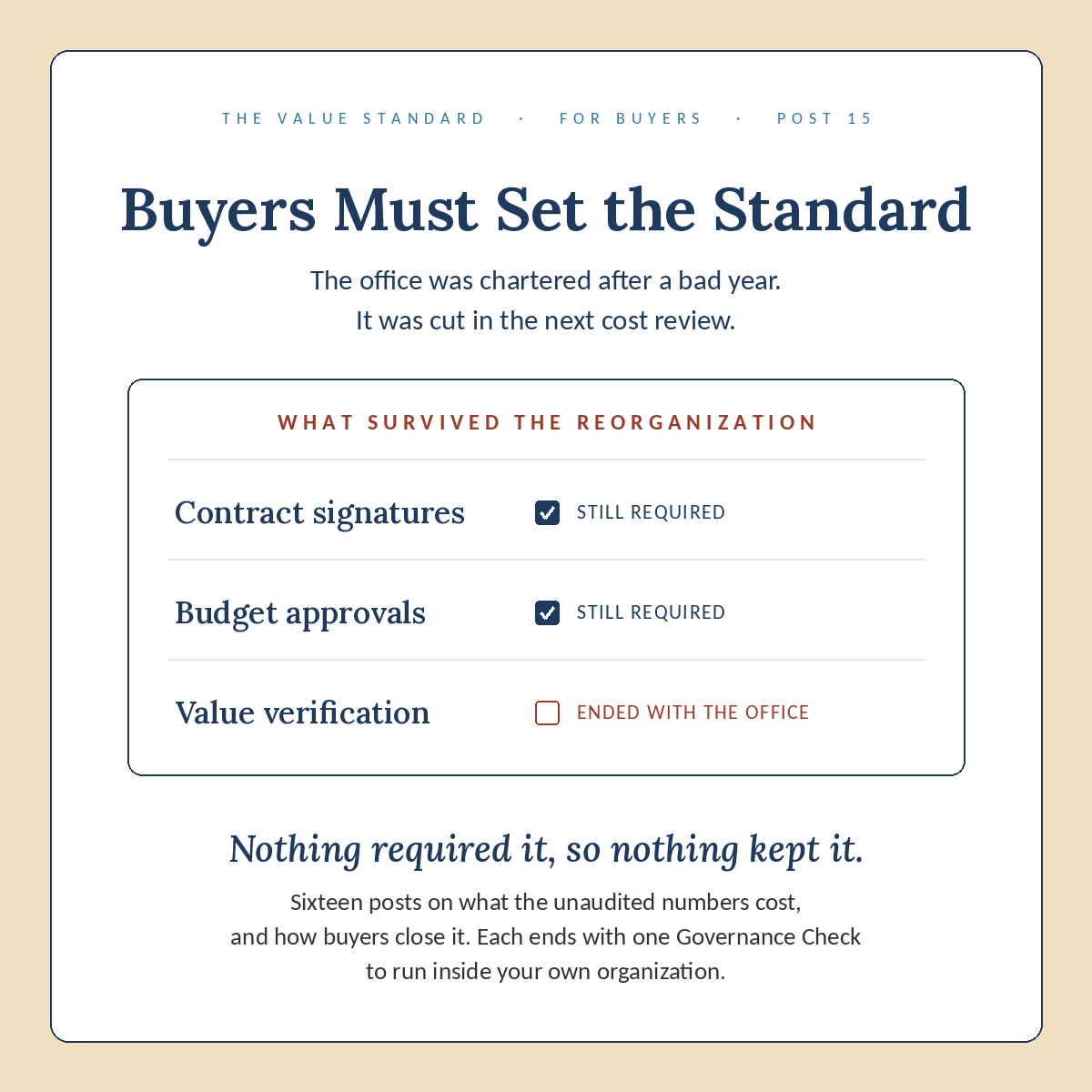
It gets chartered after a bad year. A director, a few analysts, a mandate to hold purchases to their business cases. For a while it works, because the people are good and the memory is fresh. Then the sponsor moves, the cost review arrives, and the office is the cleanest line to cut because nothing it did was required by anything.
That last clause is the whole problem. Nothing made governing value a condition of buying, so when the place closed the practice closed with it.
A standard sits somewhere else. It lives in the documents a purchase must produce to proceed: the definition of value the buyer writes before any vendor is in the room, the memo that records what the decision was approved on, the record that says afterward whether it arrived. Nobody staffs those. They are required, the way a signature is required, and a reorganization cannot remove a requirement by removing a desk.
Most organizations have built the office at least once. Fewer have written the requirement, because a requirement gets no launch and no one to congratulate.
I wrote about why the office keeps getting rebuilt and what holds value governance in place after it goes: https://valuelattice.com/the-office-is-not-the-standard/
Governance Check: Ask what would happen to value verification in your organization if the team that does it were dissolved next quarter. If the answer is that it would stop, it was never a standard.
A purchase has a clear beginning. A requirement, a competition, a signature, a date everyone remembers.
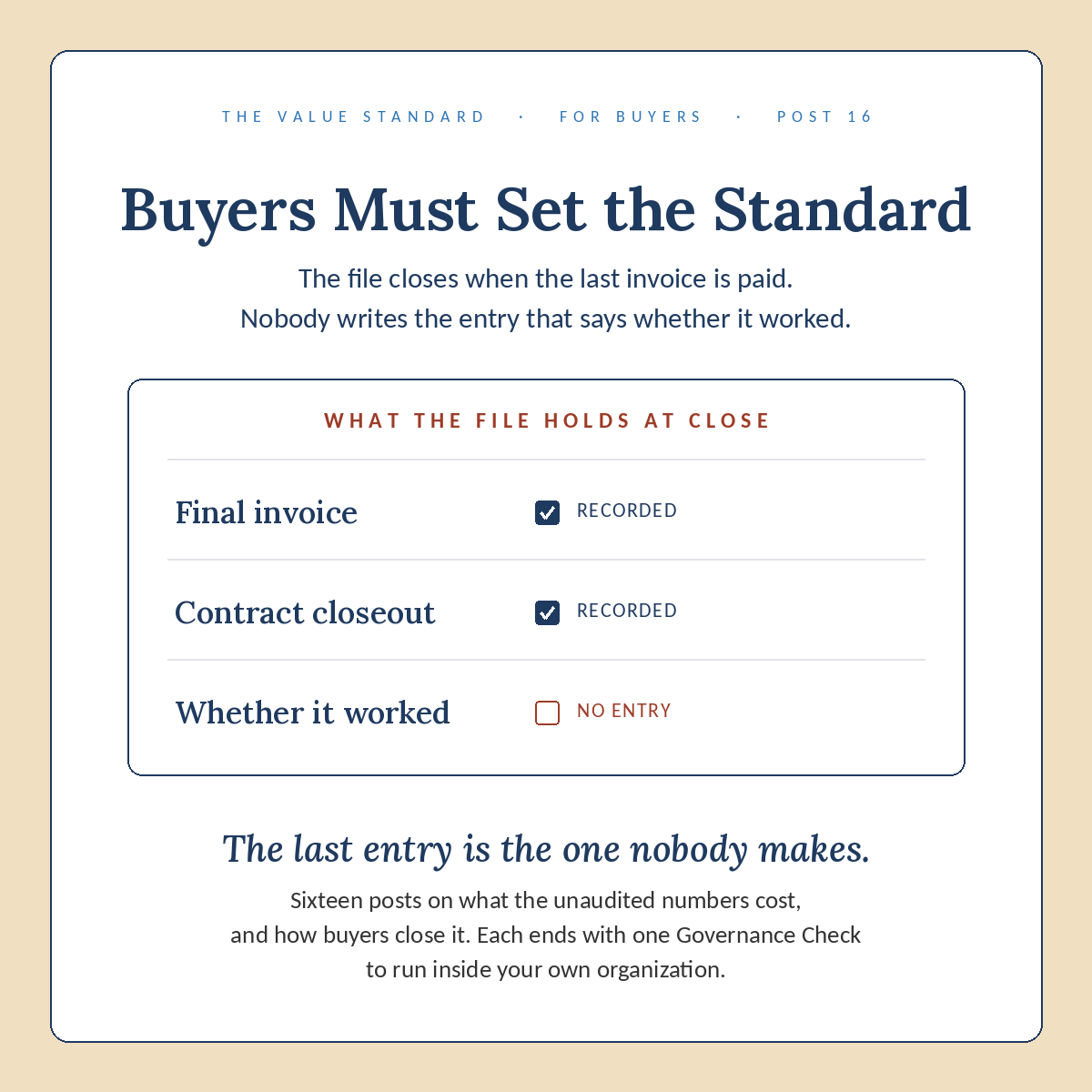
It has no ending. The last thing that happens to most purchases is a final invoice, and then the file stops. Nobody convenes to say whether it worked, because there is no document that would be read at that meeting.
This series started sixteen posts ago on one gap: value claimed during evaluation, value verified afterward. Everything since has been a single mechanism. The buyer writes the definition before any vendor is in the room. The definition survives the contract and gets reviewed on a cadence. It holds because it is a requirement rather than a staffed office.
This is the last piece, and the one that makes the other three count. A closing entry. On a named date, against the definition written at the start, someone records what the purchase produced and puts their name on it. It can be a page. It has to exist, and it has to be the buyer’s.
Without it the first three are a process that never resolves. With it, the next renewal, the next reference call and the next business case begin with something on the buyer’s side of the table. The vendor that delivered has the most to gain from that entry, because it is the only record that tells a real result apart from a competitor’s promise.
Sixteen posts is the whole of it. The book sets it out end to end: https://valuelattice.com/the-value-standard/
Governance Check: Read the file on the largest purchase your organization closed two years ago and look for the entry that says whether it worked. If the newest document in that file is an invoice, the purchase was completed rather than verified.
The book behind the series: The Value Standard. The instruments it hands the buyer: Instruments. The longer argument: White Papers.
The Standards Ledger
Some topics need more room than a blog post. Those go into The Standards Ledger, a free newsletter by Michael Brey, sent through Substack. Subscribers get one long essay by email about every six to eight weeks, and each issue also stays online to read later. It is written for the people who approve purchases and answer for what they deliver. Unsubscribe anytime.
On LinkedIn, follow Michael Brey or the Value Lattice page.