
How Your Vendors Will Respond to a Request for Value
← Back · ACT III · Chapter 18: VITAL: How Sellers Operate Within Governed Systems
The objections are predictable, a few of them are fair, and the vendor with real results has the most to gain from the page.
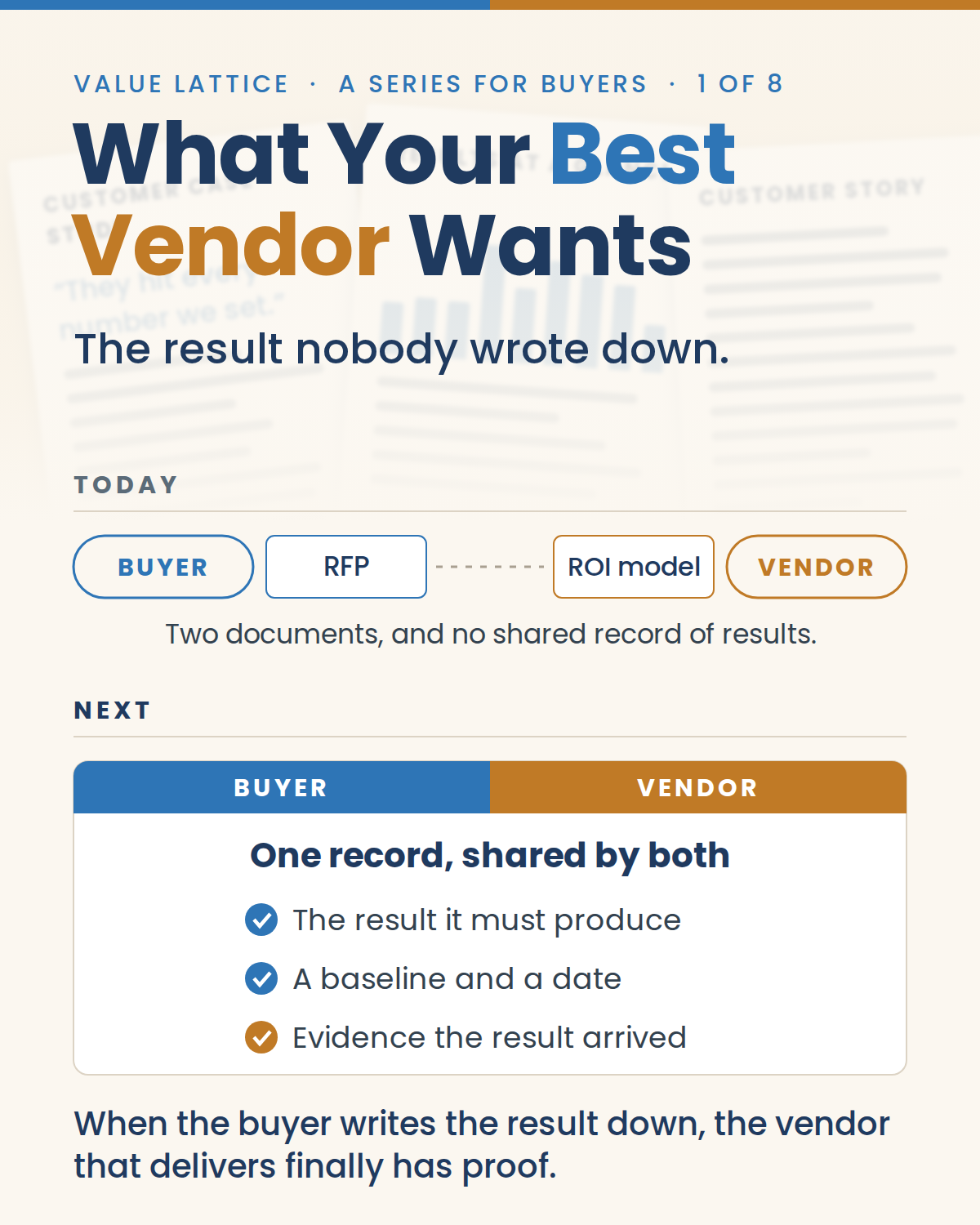
The first time a buyer attaches a Request for Value to an RFP, somebody on the vendor side reads it twice. The page is short. It asks for things a sales process was never built to supply: the outcomes the purchase must produce, in the buyer’s own terms, the metrics and baseline that will measure them, the conditions that must hold on both sides, the evidence a claim needs before it counts, and how the responses will be compared. The buyer’s business owner wrote it before any vendor was called.
I spent most of my career on the other side of that page, building the business cases vendors hand to buyers. So I can tell you roughly what will come back, because we would have said most of it ourselves. Some of it deserves a straight answer, and a buyer who gives one will learn more about the vendors in that one exchange than a stack of references would tell them.
“This will slow the decision down”
This usually arrives first, and it often goes to the CFO rather than to procurement.
It is partly right. Writing one page well takes a business owner some real time, and a vendor answering it has to do work its standard deck does not cover. What it does not do is add a scoring matrix, a new platform or a second evaluation. The RFP still collects capability, security and price. The RFV adds the part the RFP was never built to carry.
Those hours are spent early, while they are cheap, and nobody sees the return until renewal, when someone has to decide whether the purchase worked and would otherwise be arguing from a vendor dashboard.
“We can’t commit to outcomes we don’t control”
This is the fair one, and it is the objection the page was designed around.
A vendor cannot promise a five percent reduction in inventory if the buyer’s warehouse never adopts the new process. Everyone who has worked a deal knows that, and a vendor that refuses to sign up for an outcome resting on the buyer’s own behavior is being honest, not difficult.
That is what the conditions line is for. The buyer writes down, before the purchase, what has to be true on its own side for the outcome to arrive: the adoption, the process change, the clean data, the people in place. The vendor is then measured against an outcome whose preconditions were stated, instead of against a number that assumed a perfect customer. When the result misses, the review asks which condition failed, and the answer is usually on the page. The vendor gets a fair basis for being held to account, which it rarely has today.
Some buyers already write it this way. School districts that pay edtech vendors partly on student results put the district’s own side into the same contract. Digital Promise, which studied the first cohort of districts, puts it plainly: “Districts are accountable for implementing the tool at the intended dosage,” meaning how much and how often students actually use it. It reports usage under those contracts running “10 times higher than those typically seen under traditional contracts,” with districts meeting the dosage requirement for 50 to 95 percent of participating students. Those are early figures from one cohort, and the researchers argue for stronger mutual accountability sections rather than calling the problem solved.
“Let us run our value realization methodology for you”
Many vendors have one, and plenty of them are competent. We built them to capture a baseline, model the return, and review the result after go-live, and the good teams did it carefully.
The trouble is the seat the work is done from. A vendor’s business case exists to help a purchase decision get made, and whoever writes the outcome also tends to pick the metric and set the baseline, which together decide what counts as improvement. A vendor doing that in good faith still sees the buyer’s business through its own product. No bad intent is needed for the numbers to lean.
So the useful answer is yes, with one change. The buyer keeps the page, and the vendor’s method helps fill it in. A vendor that can populate the buyer’s outcomes with evidence, propose a measurement the buyer accepts, and commit to reporting against the buyer’s metrics after go-live is a stronger vendor than one that insists on its own template. The RFV is how the buyer finds out which one it is talking to.
“Your baseline is wrong”
Sometimes it will be. Plenty of organizations have never measured the thing they are about to spend money to improve, and the RFV exposes that the first time someone tries to fill in the metric line.
A vendor pointing this out is doing the buyer a favor. The answer is to mark the baseline as provisional, name the assumption behind it, and make that assumption the first thing the post-go-live review checks. A provisional number that everyone can see is more useful than a precise one nobody can defend. What the buyer should not do is let the vendor supply the baseline and then measure the vendor against it.
“Outcome commitments cost more”
Some vendors will price the commitment, and a buyer should expect that on the first few. Asking a supplier to report against metrics it did not choose shifts real risk, and suppliers price risk.
That price is information. A vendor with results at comparable customers under comparable conditions has less reason to charge for the commitment, because it already knows roughly what happens after go-live. A vendor that prices it steeply, or declines to commit at any price, is telling the buyer something about how confident it is. Either way, the buyer learns it before signing rather than at renewal.
Who welcomes the page
Not every vendor objects, and the ones who don’t are worth noticing.
Take the vendor whose last implementation actually hit its number. The proof of that sits in a case study the vendor published about itself, and the next buyer discounts it the way buyers discount every case study. So in the evaluation it reads much like the competitor that has only promised. Neither can point to a result the customer defined before the purchase and checked after it.
The RFV gives that vendor a record it did not write. At renewal, it can argue from the buyer’s own page that the outcomes arrived. In the next evaluation, its evidence at comparable customers is exactly what the page asks for. A vendor with a thin record will prefer the old arrangement, which is its own kind of signal.
For those of us who built value cases for a living, the page would have helped too. We spent a lot of effort proving value to buyers who had no way to check it, and the realizations we did measure were never added up anywhere a buyer could see them.
What usually happens
The pattern The Value Standard records in its composite case is familiar to anyone who has sat through a procurement escalation. In week six the incumbent vendor calls the CFO directly to say the process will slow the decision, and the CFO hands the conversation to the CPO. The CPO holds to the requirement, and after one more escalation the vendor complies.
What carried it through was a written requirement the vendor had to answer, rather than a preference someone could be talked out of. The objections tend to arrive on the first page, and the vendors worth keeping usually answer them there.
The white paper The Request for Value: The one page procurement never asked for, where it goes in the process, and how to issue it Monday includes the page itself as a form and is available at valuelattice.com/white-papers/the-request-for-value/. The composite case is from The Value Standard (2026), Chapter 20, “The Buyer Value Practice,” in the section “The First 90 Days.”
Keep reading: ACT III · Chapter 18: VITAL: How Sellers Operate Within Governed Systems
The Standards Ledger
Some topics need more room than a blog post. Those go into The Standards Ledger, a free newsletter by Michael Brey, sent through Substack. Subscribers get one long essay by email about every six to eight weeks, and each issue also stays online to read later. It is written for the people who approve purchases and answer for what they deliver. Unsubscribe anytime.
On LinkedIn, follow Michael Brey or the Value Lattice page.