
Europe’s Draft Rules Reward Quality at Signing and Stop There
← Back · ACT II · Chapter 9: The Value Control Loop
On September 9, 2026, the European Commission published COM(2026) 590, a proposal to repeal the three procurement directives of 2014 and replace them with one directly applicable Regulation covering public contracts, utilities and concessions.
It is a proposal. Nothing in it applies yet, the text carries a deferred entry into application of two years, and the Commission gives itself an evaluation seven years after entry into force. Anyone reading it as current law will get the timing badly wrong.
The shape of it is worth reading now, because that shape is a governance design, and it will be argued over in public for the next two years by people who can still change it.
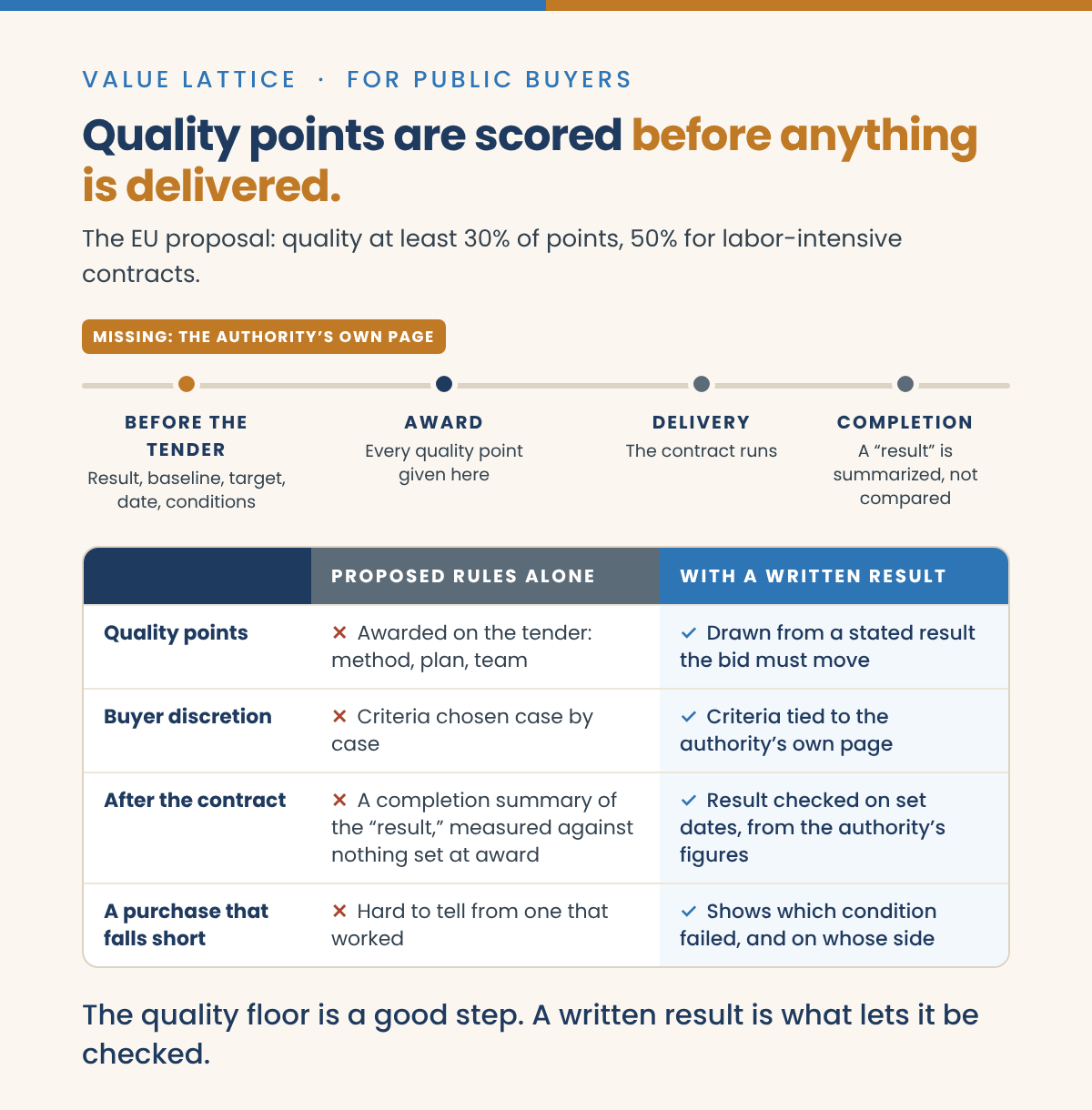
The award side of the design is specific and quantified. Recital 42 says public contracts “should, as a general rule, be awarded on the basis of the best price-quality ratio”, then sets a number: “A minimum weighting of 30%, and 50% for by their nature labour-intensive contracts whereby the 50% should include significant social considerations, should therefore be provided for quality criteria in the award phase”. A buyer may go below the floor, but only by showing that quality is secured some other way, through specifications or through conditions for performance of the contract.
The Care Is All In The Scoring
The recital does not stop at the number. It prescribes how the quality score should be reached: separating price and quality assessments, “securing the ‘four eyes principle'”, running individual evaluations before collective deliberation, keeping a documented audit trail, and publishing all scoring justifications for high-value contracts.
That is a serious apparatus and it is pointed at one moment. It governs how a buyer decides which promise is the best promise.
The reason given for the whole arrangement sits in the same recital. Putting quality at the center of public purchasing, it says, lets buyers acquire works, supplies and services “that provide better guarantees for meeting their needs in a longer term perspective”.
That word, guarantees, is doing a lot of work. A guarantee is a claim about the future made at the point of purchase, and whether it was worth anything only gets settled later, when somebody looks.
The operative text does not leave this to a recital. Article 98(2) defines quality criteria as “any criteria used to assess the degree to which a tender proposes beneficial, efficient or sustainable outcomes in relation to the subject-matter of the contract.” The verb is proposes, and it sits in a binding article, so the thirty percent is weighted against what the bid says it will produce.
What The Regulation Actually Watches
The proposal does build a monitoring architecture, and it is substantial. Every Member State establishes or designates a National Public Procurement Data Space as the central national access point for procurement and contract lifecycle data. Those feed a Union-level Public Procurement Data Space run by the Commission. Member States must “establish an evidence-based framework to monitor the functioning of their public procurement systems and markets and to make the results of that monitoring publicly available at least once a year”, and report to the Commission on what they found. The Commission provides an analysis of the public procurement system across the Union every three years.
Recital 56 says what that national monitoring should cover: “barriers to competition and market access, including for SMEs, vulnerabilities to corruption and fraud, supply-chain dependencies, and the uptake of sustainability, innovation and digitalisation”.
Read that list again with a single purchase in mind. Competition, integrity, supply-chain dependencies and the uptake of policy objectives are all measures of a market or of a process. None of them asks whether the thing that was bought did what the winning tender said it would do.
The operative article reaches a little further than the recital. Article 137 also has Member States “monitor the performance, adjustments and modifications of large infrastructure projects and long-running contracts such as concessions”. That does look at individual contracts, but only the largest and longest ones, it is the Member State doing the looking, and the text does not say what the performance is to be compared with.
What The Text Asks For After Signature
The Commission’s own description of the text says where the post-award rules live. The horizontal provisions covering all contracts address “contract execution, including modification and termination of contracts, adjustment mechanisms, payments, and publication and documentation requirements”. The concessions part covers “concession duration and contract management (such as modifications and termination)”.
That summary undersells the articles in two places, and both matter to a buyer.
Every contract within the Regulation’s scope ends with a public record. Under Articles 110 and 111, within 20 days of completion the buyer sends a public summary of completion, and that summary includes the “result of the contract including information on termination”. The text does not say what the result is to be measured against. It is not tied to the quality criteria that carried thirty percent of the award, or to anything the winning tender proposed.
Concessions get considerably more. Under Article 119 the buyer may set performance conditions as “clear, objective and measurable performance requirements”, including indicators for the quality of service, and the procurement detail “may in particular include” key performance indicators, methods for monitoring and verifying performance, and the consequences of the results. Article 121 requires every concession contract to oblige the concessionaire to keep records and report so that the buyer can monitor performance. For an ordinary contract, conditions on performance under Article 104 are something the buyer “may” lay down.
So the proposal does ask for a record at the end of every contract, and for concessions it builds the means to check. What it does not require, for any contract, is a comparison between what was delivered and what the quality points were awarded for.
The First Objections Went To The Other End
Within hours of publication, Bellona Europa put out a response arguing that the quality criteria are drawn too loosely. Its policy advisor Linda Zarai said the proposal “leaves almost everything optional” and that “‘Quality’ can mean virtually anything, and public buyers could favour local content alone while forgoing environmental, social, or innovation requirements altogether”.
The Regulatory Scrutiny Board had gone the same direction earlier. It gave the impact assessment a negative opinion on April 17, 2026 and asked, among other things, for better specification of how quality would be defined under best price-quality ratio procurement, before issuing a positive opinion with reservations on June 8.
Both of them asked what quality means at the award, and neither went on to ask who confirms, once the contract has run, that the quality was delivered.
More Discretion Needs More Record
The proposal widens the room each buyer has. Public buyers choose which quality criteria to apply, and they could negotiate within the main procedures without first having to justify it. Procurement specialists have said, fairly, that a great deal now rests on the judgment of each contracting authority.
Judgment holds up when there is something written down to test it against later. Without that, the same discretion that lets a careful buyer pick sensible criteria lets another pick criteria that are easy to score and hard to check, and a few years on it is hard to say which happened. The record that settles it is the buyer’s own, written before the tender goes out.
A Buyer Does Not Have To Wait For This
None of this needs a Regulation. A buyer already has the authority to write the look-back into its own contract: what evidence will show the quality arrived, who produces that evidence, on what date, and what follows if it does not. Written before signature, that becomes part of the record the buyer keeps. Raised once the work is done, the same question turns into a negotiation with the supplier whose work is being measured, which is a far weaker place to ask from.
The proposal makes that easier to write than it might sound. Article 88 requires specifications to be set out “in objective, clear and measurable terms” and, as a rule, as functional requirements describing the “performance, desired function, capability, outcome or result” the purchase must achieve. A requirement written that way is one the buyer can check against later. A supplier that expects to deliver loses nothing by the check, because it produces the one record that shows its result rather than its bid.
Britain has already taken the first step of putting a supplier performance verdict on the public record. The European proposal, on a market its own Executive Vice-President put at around 2,500 billion euros, is currently designed to know a great deal about how contracts are awarded and much less about whether they returned what the award paid for.
Two years of negotiation remain, and the award side of the text will take most of the attention, because that is where the money moves. Checking what the money bought against what the award was given for is still left to the buyer, in Europe as everywhere else.
See also Procurement Prices Every Concession and Never Checks the Result, on the concession-pricing apparatus and the verification line it leaves out, and Australia’s Munitions Contract Let the Supplier Grade Itself., on an audited contract that wrote capability and cost in as purposes and attached its profit lever to the operating baseline.
References: European Commission, COM(2026) 590, Proposal for a Regulation on public contracts and concessions, published September 9, 2026. Bellona Europa press release, September 9, 2026.
Keep reading: ACT II · Chapter 9: The Value Control Loop
The Standards Ledger
Some topics need more room than a blog post. Those go into The Standards Ledger, a free newsletter by Michael Brey, sent through Substack. Subscribers get one long essay by email about every six to eight weeks, and each issue also stays online to read later. It is written for the people who approve purchases and answer for what they deliver. Unsubscribe anytime.
On LinkedIn, follow Michael Brey or the Value Lattice page.