
The Vendor Wrote Your Business Case. Nobody Ever Added It Up.
← Back · ACT II · Chapter 14: Who Controls Value Engagement?
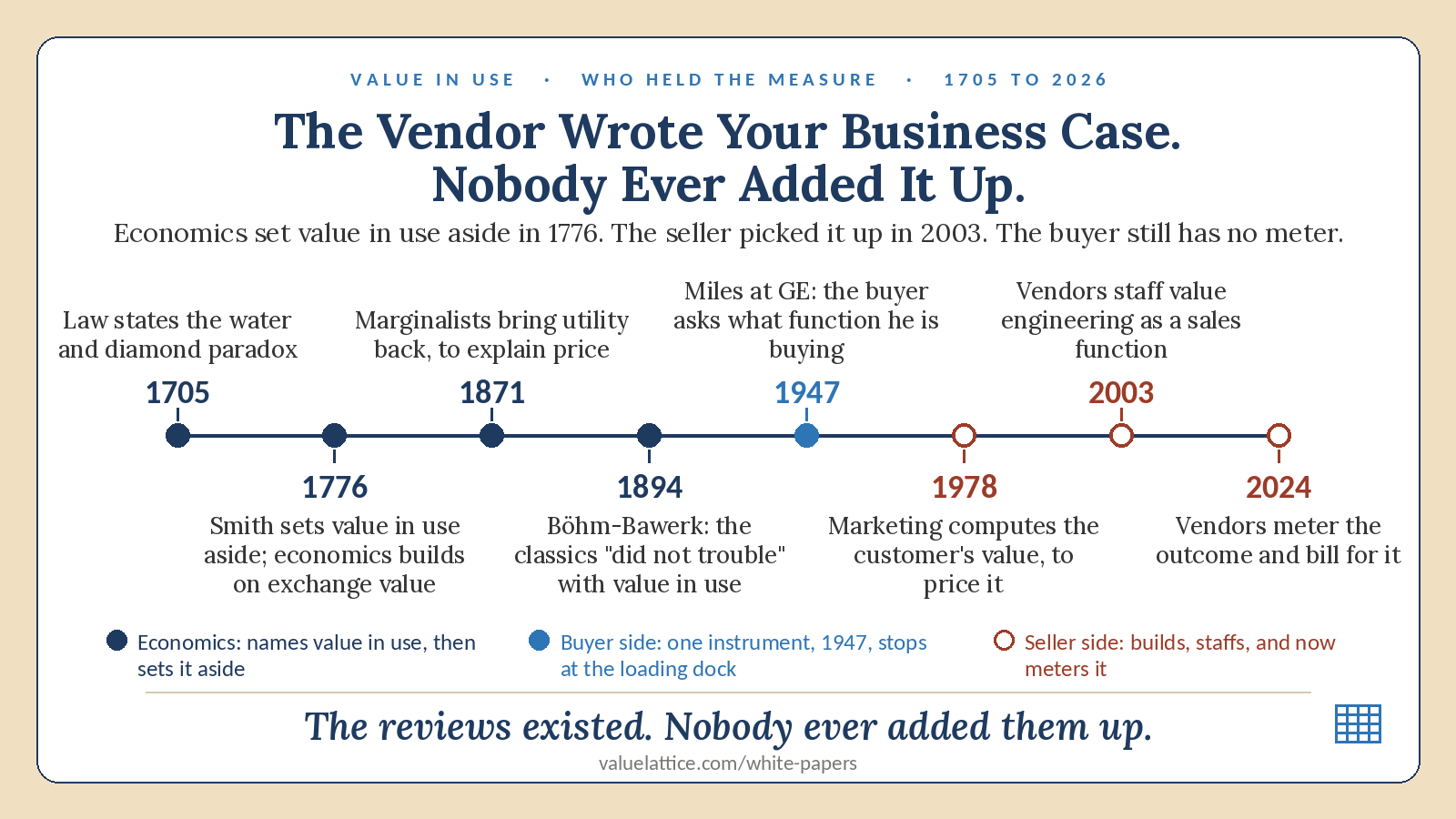
Economics set value in use aside in 1776, and sellers picked it up around 2003, which left the buyer with no instrument of its own.
Every purchase carries two numbers: what you paid, which is on the invoice, and what it did for you, which is not recorded anywhere.
The gap runs across the whole profession, and it has a history that goes back to 1776: from Adam Smith’s decision to set aside “value in use” and build economics on “value in exchange,” through a century of business measurement built on price and cost, to the moment, around 2003, when the enterprise software industry built the only working instrument for quantifying value in use that most buyers have ever encountered. This post is the short version. The full account, with the sources, is a white paper called The Bracket.
The number that was set aside
Smith named the two kinds of value, illustrated them with water and diamonds, and then, in the next paragraph, went looking for a measure of exchange. He never built on value in use. The economists who followed him developed a rich theory of how utility explains price, and later built real instruments for measuring the value of public works. Those instruments are mandated in public procurement to this day. A private company buying a system is bound by none of them.
So business measurement grew up on the side of the line where the numbers were. Accounting records exchanges. Capital budgeting discounts exchanges anticipated. Total cost of ownership instrumented the cost half of a purchase completely. By the end of the 1980s a buyer could tell you what an asset would cost over its life, to the dollar. Whether it would deliver what it was bought for was answered by judgment and relationships. There was no instrument.
Who picked it up
When value in use came back into commercial practice, it came back through marketing. A 1988 McKinsey staff paper made the “value proposition” its organizing idea, and the phrase describes something the business proposes and the customer receives. The 1998 Harvard Business Review article that defined customer value modeling says its purpose is to let suppliers “provide evidence to customers of their accomplishments.” The supplier builds the model, and the customer is what it measures.
Then, by the vendors’ own account, enterprise software companies staffed it. In a 2015 interview, SAP’s Chief Customer Value Officer said the company had been doing value engineering since 2003. Teams recruited from the strategy firms built four things: a benchmark database, a business case model, a value hypothesis linking product to outcome, and a realization review to run after go-live. Delivered free. The seller designed and ran every one of them, with the buyer’s numbers as inputs.
That apparatus became a job title and a department, with its own category of software, and the question of what a purchase delivered after the sale became one the vendor’s customer success team answers.
What has never been published
The realization reviews were real. I ran them. Deal by deal, we re-surveyed the customer’s indicators, compared them to the baseline and the forecast, and the customer’s sponsor signed the report.
What never happened was aggregation. Nobody added them up. Nobody asked, across a hundred deals, what fraction of the projected value arrived. I have not found a vendor value engineering function that has published that figure.
The figures that do exist are not encouraging. Gartner’s 2024 survey of 3,186 CIOs and technology executives found 48 percent of digital initiatives meeting or exceeding their business outcome targets. Bain’s 2026 survey of 951 companies found 44 percent funding the next wave of AI from earlier automation savings that, in Bain’s words, “have consistently come in below target.” So each unverified projection pays for the next one, and nothing in the chain checks whether the first one arrived.
Why this stopped being a history lesson
Until recently the gap could be carried. The price was fixed at signing, the value arrived or did not, and the shortfall was absorbed into the next budget.
In August 2024, one vendor announced that customers would pay only for issues its AI agents resolved. In June 2026, another announced pay-per-resolution: charged when the agent resolves an issue start to finish, no charge if the customer asks for a human. That is the alignment of price to value buyers have wanted for as long as there have been buyers. It also puts the missing instrument on the bill, because in every one of these arrangements the vendor defines the resolution, the vendor counts it, and the meter is the vendor’s dashboard.
The debt
I call the vendor-built era a failed experiment, in a narrow sense. For twenty years buyers tested, with real money and at scale, whether an apparatus built for the seller’s decision could stand in for their own, and they let the seller keep the count. The data to answer that question existed, and nobody in a position to add it up ever did.
What it left is a debt: the instrument for governing value in use, in private technology purchasing, has still not been built by the party whose money is at risk. The Bracket sets out where that instrument went, who has been holding its substitute, and what it would take for the buyer to write the standard the seller responds to.
The party whose money is on the scale needs its own meter.
A live example of the same gap: Gartner now advises CIOs to terminate any AI investment that cannot show business value within ninety days. Ninety Days to Prove AI Value works through what that deadline has to run against.
The white paper The Bracket: How economics set aside value in use, how the seller picked it up, and why the debt is now due is available at valuelattice.com/white-papers/. Sources cited above: Smith, Wealth of Nations I.iv (1776); Lanning and Michaels, McKinsey Staff Paper 41 (1988); Anderson and Narus, HBR (1998); Bouhdary interview, Apps Run The World (2015); Gartner CIO survey (October 2024); Bain Automation and AI Pathfinder Survey (June 2026); Zendesk (August 28, 2024) and Salesforce (June 25, 2026) pricing announcements.
Keep reading: ACT II · Chapter 14: Who Controls Value Engagement?
The Standards Ledger
Some topics need more room than a blog post. Those go into The Standards Ledger, a free newsletter by Michael Brey, sent through Substack. Subscribers get one long essay by email about every six to eight weeks, and each issue also stays online to read later. It is written for the people who approve purchases and answer for what they deliver. Unsubscribe anytime.
On LinkedIn, follow Michael Brey or the Value Lattice page.