
“A forceful, thought-provoking explanation of a system for better results in business.”
· Kirkus Reviews
“Brey is a brisk and energetic prose stylist.”
· Kirkus Reviews
Available now · First Edition
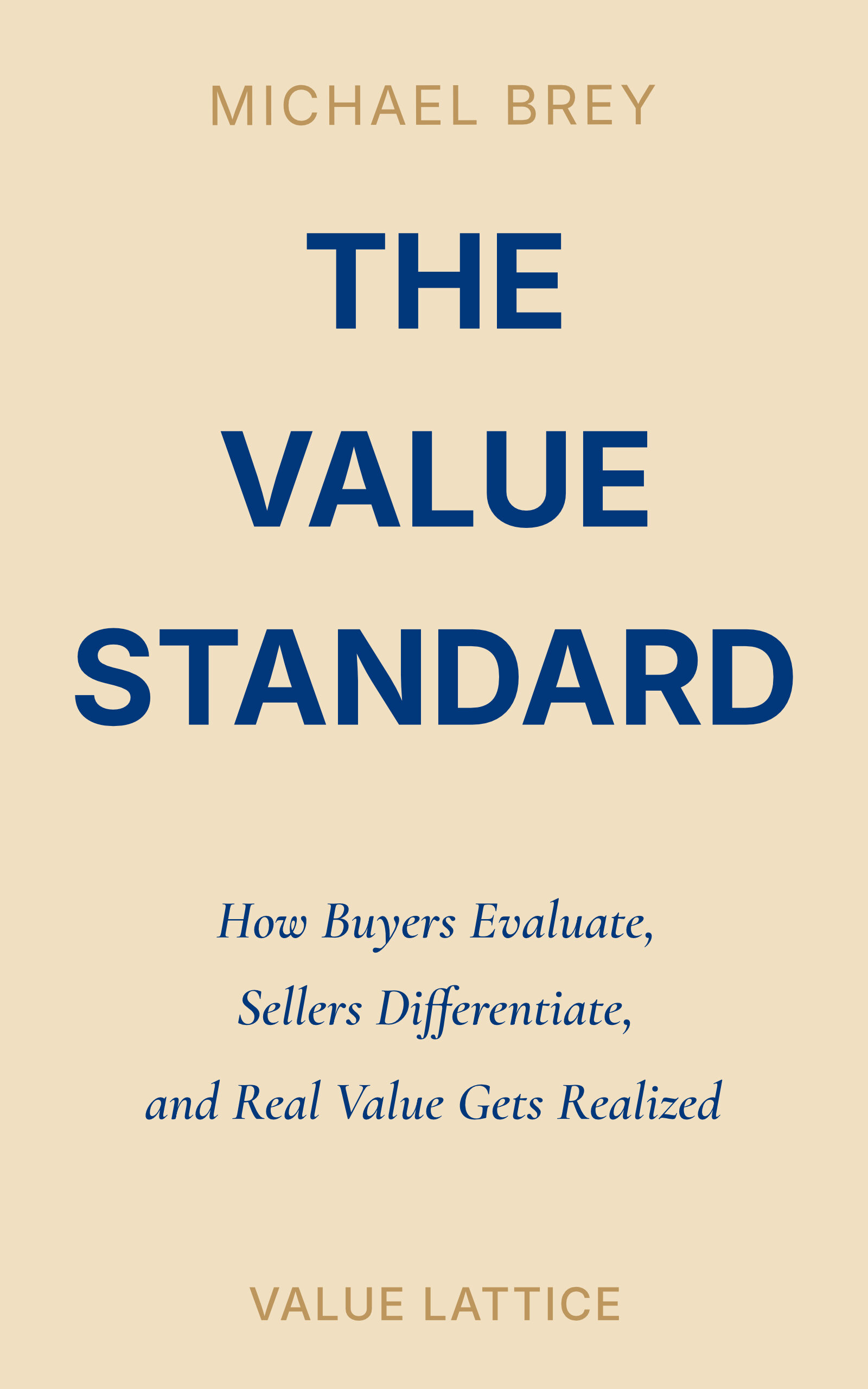
The Value Standard
A buyer-governed system for defining, validating, executing, measuring, and adjusting value.
B2B value is usually asserted, not proven. It is a story told by the seller and taken on trust by the buyer. The Value Standard hands the structure back to the buyer, turning value from a promise into something governed into existence and verified over time.
Your local bookstore
The Value Standard is in the global book catalog. Any store can order the book by ISBN: 979-8-9957844-1-8 (hardcover), 979-8-9957844-0-1 (paperback), 979-8-9957844-2-5 (eBook).
Reviewers and event organizers can request a review copy.
Inside the book
Twenty-three chapters in three acts
The full table of contents, with each chapter’s premise in a line. Open an act to explore.
ACT I. Why the Current Value System Fails
Each chapter title links to the posts that extend it.
1. The Illusion of Value
Why most organizations think they have value when what they actually have is the documentation of value. The distinction matters, and most miss it.
2. The Broken Value Flow
Value is committed by one team, executed by another, measured by a third. Each handoff loses what the prior one promised.
3. Value Drift
Value Drift is what moves outcomes silently away from what was approved. Three forces drive it. Naming them is the first step to governing the drift.
4. The Information Asymmetry Collapse
Buyers never operated on trust. They operated on systems built to compensate for what trust could not deliver. As asymmetry collapses, those systems meet a new reality.
5. Advisory Is Not Enough
Advisory improves decisions but cannot govern outcomes. The boundary ends where execution begins, and that is exactly where value is lost.
6. Tech Bloat as Governance Failure
Technology accumulates not because it works, but because outcomes are not managed. Tech bloat is governance failure expressed through systems.
ACT II. How Value Actually Forms, Drifts, and Becomes Credible
Each chapter title links to the posts that extend it.
7. Value Is Not Promised; It Is Proven
Mature markets move from promise competition to proof competition. The organizations that govern proof produce the value the rest only project.
8. The Buyer Lifecycle Is Progressive Governance
The Buyer Lifecycle is not a procurement workflow. It is a progressive governance architecture that turns evaluation, decision, execution, and outcomes into a continuous discipline.
9. The Value Control Loop
Value is a controlled process, not a fixed state. The Value Control Loop is the mechanism that keeps governance running after the decision is made.
10. The Buyer Governance Pyramid
Outcome, execution, and decision governance form a single pyramid. Separating them collapses accountability. Integrating them is the structural difference.
11. Outcome Credibility Markets
Markets are shifting from promise to proof. The Request for Value (RFV) is the instrument the buyer hands the seller when narrative no longer wins the evaluation.
12. Compounded Value
Value is built over time, not delivered at a moment. Sustained governance produces compounded outcomes; abandoned governance produces a single harvest.
13. The AI Amplifier
Artificial intelligence amplifies what governance produces. Where governance is strong, AI compounds returns. Where governance is absent, AI accelerates the collapse.
ACT III. How Value Is Governed Into Existence
Each chapter title links to the posts that extend it.
14. Who Controls Value Engagement?
Authority over value engagement has shifted. Buyers who exercise it formally produce outcomes; buyers who assume it remains with sellers receive narratives.
15. The Value Lattice System
The Value Standard becomes operational when its components interlock. The Value Lattice is the system that connects evaluation, execution, realization, and verification into one structure.
16. MAVEN: Controlled Evaluation
MAVEN gives buyers a system for evaluation that vendor narrative cannot bend. The buyer defines the structure; the vendor responds inside it.
17. VIGOR: Governance and Realization
VIGOR governs what happens after the decision. It is the realization layer that converts approved value into measured outcomes through sustained execution.
18. VITAL: How Sellers Operate Within Governed Systems
Once buyers govern, sellers must align. VITAL is the structure that turns seller behavior from narrative delivery into outcome alignment, within buyer-controlled systems.
19. Preemptive Value Architecture: The Buyer’s Declaration
The buyer’s formal declaration of governance architecture to the seller ecosystem. PVA is how the reorientation extends from internal governance into the relational dimension.
20. The Buyer Value Practice
Value governance becomes an institutional capability, not an initiative. The Buyer Value Practice embeds the discipline in roles, processes, and measurement cadence.
21. Decision Artifacts That Govern Outcomes
Decisions vanish without artifacts. The records that preserve commitments, expose deviations, and survive the decision cycle are what convert intent into governed outcomes.
22. Embedding Buyer Governance
Initiatives end; capabilities endure. Embedding buyer governance turns the discipline into institutional memory and operating reflex, so value compounds without depending on individuals.
23. The Future of Value
The future of value is already happening. Markets that reward proof produce a different kind of seller and a different kind of buyer.
Plus a preface and introduction, canonical definitions, contested market terms, acronyms, a reading path, an implementation architecture, and a full research bibliography.
Value is governed into existence, not persuaded into belief.
THE OVERVIEW
The book at a glance
What
A buyer-governed value system
A standard for defining, validating, executing, measuring, and adjusting value across the buyer lifecycle. Twenty-three chapters in three acts.
Why
Because value is asserted, not proven
Value is committed by one team, executed by another, and measured by a third, losing what was promised at every handoff. The book replaces that illusion with a discipline the buyer controls.
Who
Buyers, sellers, and the desks between
For buyers who evaluate and govern purchases, sellers who must differentiate on proof, and the executive, finance, procurement, and revenue leaders accountable for whether value actually shows up.
When
Available now, First Edition
Published 2026 by Value Lattice, LLC. Built to be read the way you need it: start with the chapter closest to the problem in front of you.
Where
Hardcover, paperback, and eBook
Available from Amazon, or order by ISBN through any bookstore
How
Named systems you can operate
The Value Control Loop, the Buyer Governance Pyramid, Outcome Credibility, and the open governance systems MAVEN, VIGOR, and VITAL turn the idea into practice.
INSIDE THE SYSTEM
The structures that make value governable
01
The Value Control Loop
Define, validate, execute, measure, adjust: five phases that close the gap between intent and outcome, and keep running after the decision is made.
02
The Buyer Governance Pyramid
Outcome, execution, and decision governance in one structure, scaling accountability without becoming bureaucracy.
03
Outcome Credibility
Markets shift from promise competition to proof competition. Credible outcomes win; credible narratives commoditize.
04
Compounded Value
Value is built over time, not delivered in a moment. Sustained governance compounds returns; project thinking harvests once.
05
The AI Amplifier
AI does not change what value is; it exposes whether it exists. It compounds strong systems and accelerates weak ones.
06
The Value Lattice System
The system that interlocks evaluation, execution, realization, and verification. It is the home of MAVEN, VIGOR, and VITAL.
Open governance systems: MAVEN (controlled evaluation), VIGOR (governance and realization), and VITAL (how sellers operate within governed systems). Free to use, adapt, and apply with attribution.
Posts that extend each chapter, and a record of how the ideas evolve.