
Single Posts
Single posts from LinkedIn that sit outside a series. Each one points to the longer piece it came from. Newest first; click “…more” to read a post in full.
October 26, 2026
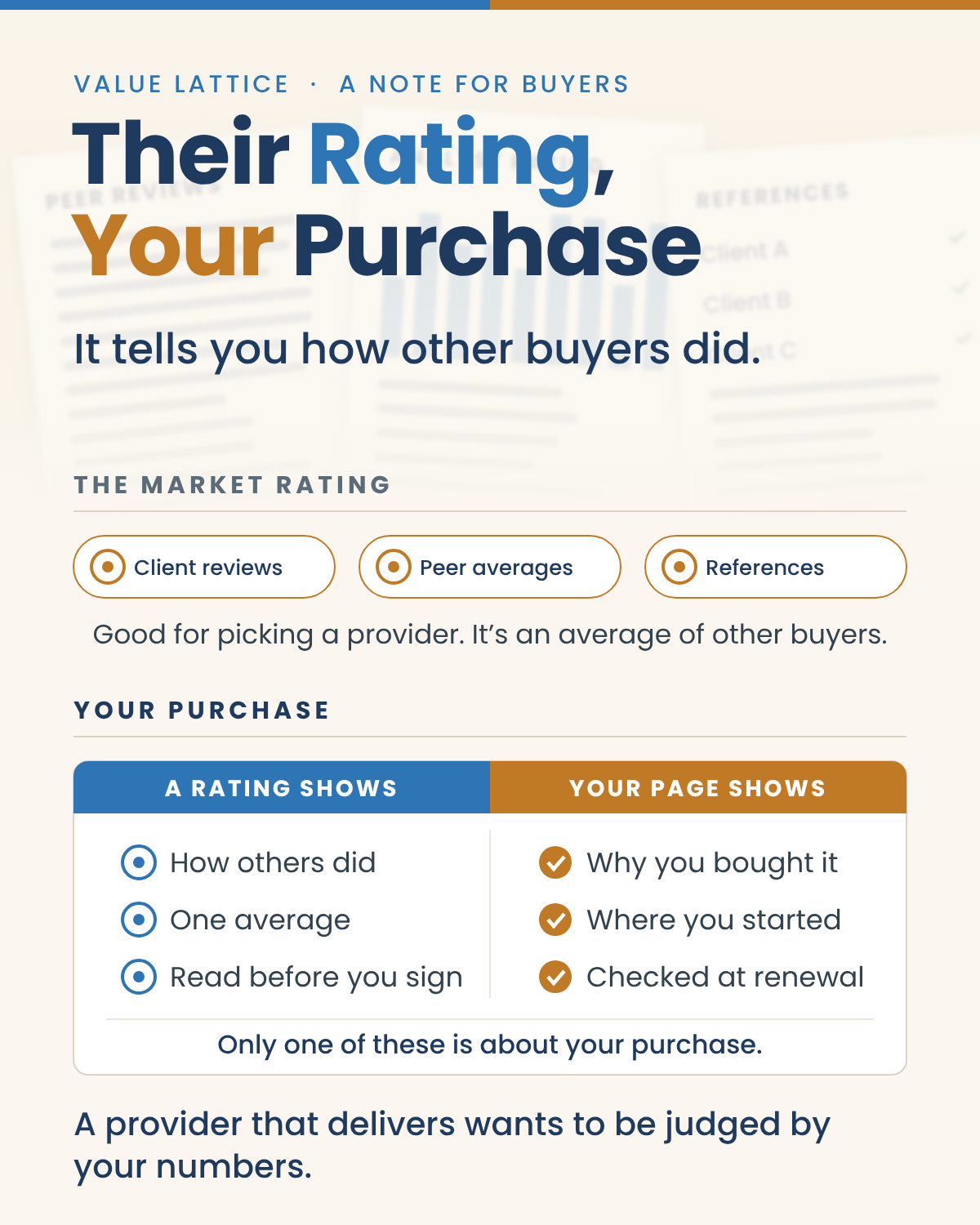
Vendor ratings are getting better, but they still can’t tell you if your own purchase worked.
Ratings used to lean on what vendors said about themselves. More of them now ask the customers, which is how it should have worked all along.
On the vendor side, though, I watched customer ratings turn into something to manage. NPS was supposed to be a neutral read. What I saw was a lot of effort spent finding anyone at the customer who’d say something nice, and that person often had no idea whether people were using the product or what it was delivering. Evaluation criteria get worked the same way, usually by whichever vendor reaches the sponsor first.
Even an honest rating is an average of how things went at other companies. It knows nothing about why you bought, or where your numbers stood the day you signed. Some of the customers in that average wrote down what they bought it for. A lot of them are going on a feeling, and the rating counts both the same.
So read the ratings when you’re choosing. Then, before you sign, write down what this purchase has to deliver, where your numbers stand today, by when, and what each side has to do. That’s the Request for Value. When someone asks you to rate the provider a year later, you’ll have more to go on than a feeling, and a provider that delivered gets credit for it in your numbers.
More on what ratings can and can’t tell you: https://valuelattice.com/analyst-ratings-rank-vendors-on-criteria-you-didnt-choose/
October 23, 2026
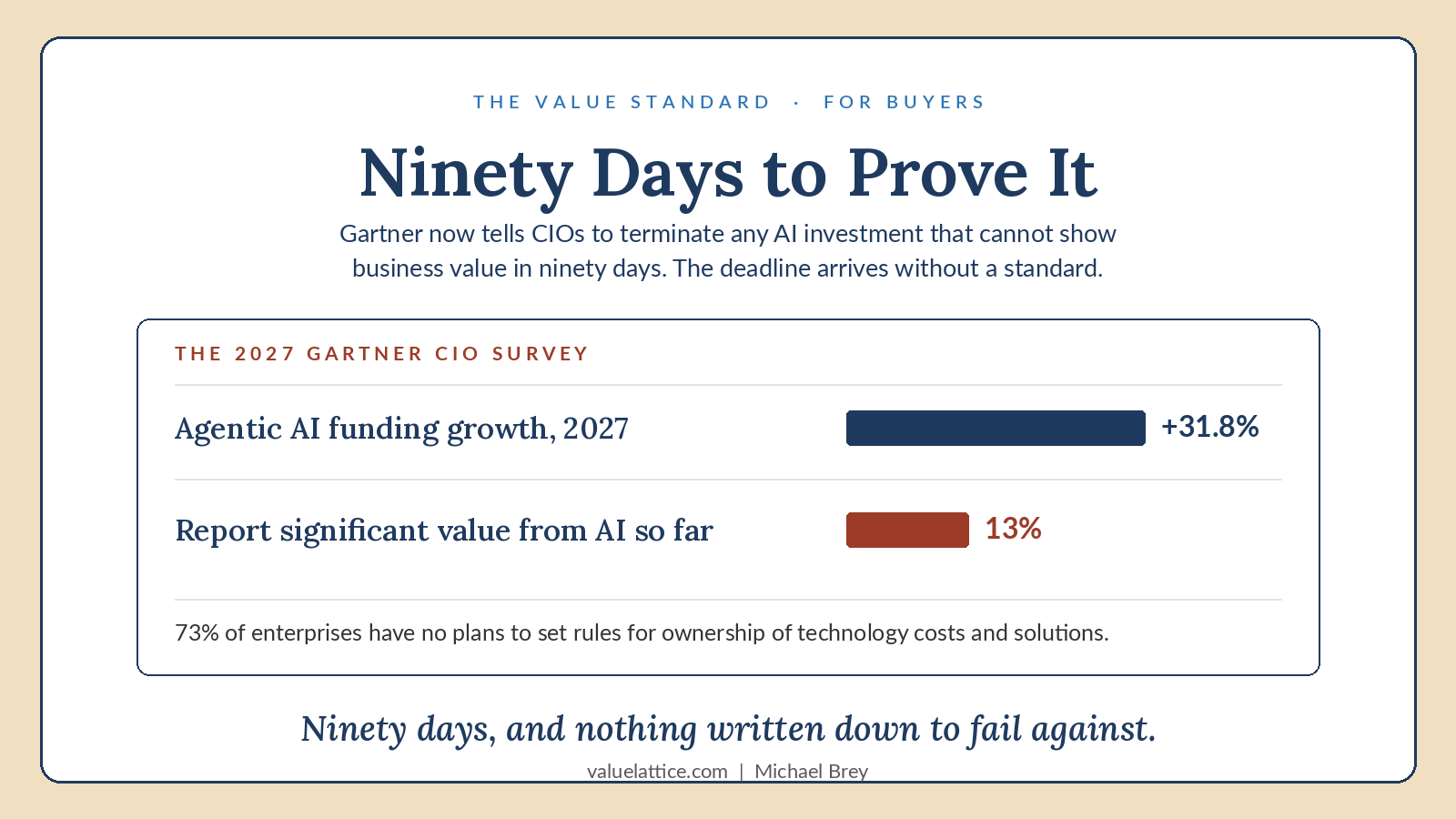
Gartner’s 2027 planning guidance tells CIOs to end any AI investment that can’t show business value within ninety days.
The same survey has funding for agentic AI rising 31.8 percent next year, the fastest-growing line in the budget. Thirteen percent of respondents report significant value from AI tools so far.
A deadline says when someone has to come back with an answer. It says nothing about what the answer is about, or who wrote the question.
On most enterprise software purchases the benefit case came from the supplier. Ninety days later the organization opens that file and finds the vendor’s definition of success sitting where its own should be, and the review confirms what the proposal said it would.
Cost at least leaves a trail. Somebody raises the purchase order, somebody approves the invoice. Nothing like that happens to the benefit the purchase was approved on, and nobody is obliged to reopen it.
The fix is one line, written by the buyer before the decision, with a figure and a date.
I wrote about what the deadline has to run against: https://valuelattice.com/ninety-days-to-prove-it/
October 19, 2026
Sellers walk into every serious deal with a prepared set of questions.
They time them carefully and use the answers to write the business case your investment committee eventually reads. On a lot of purchases, that’s the only careful discovery anyone does.
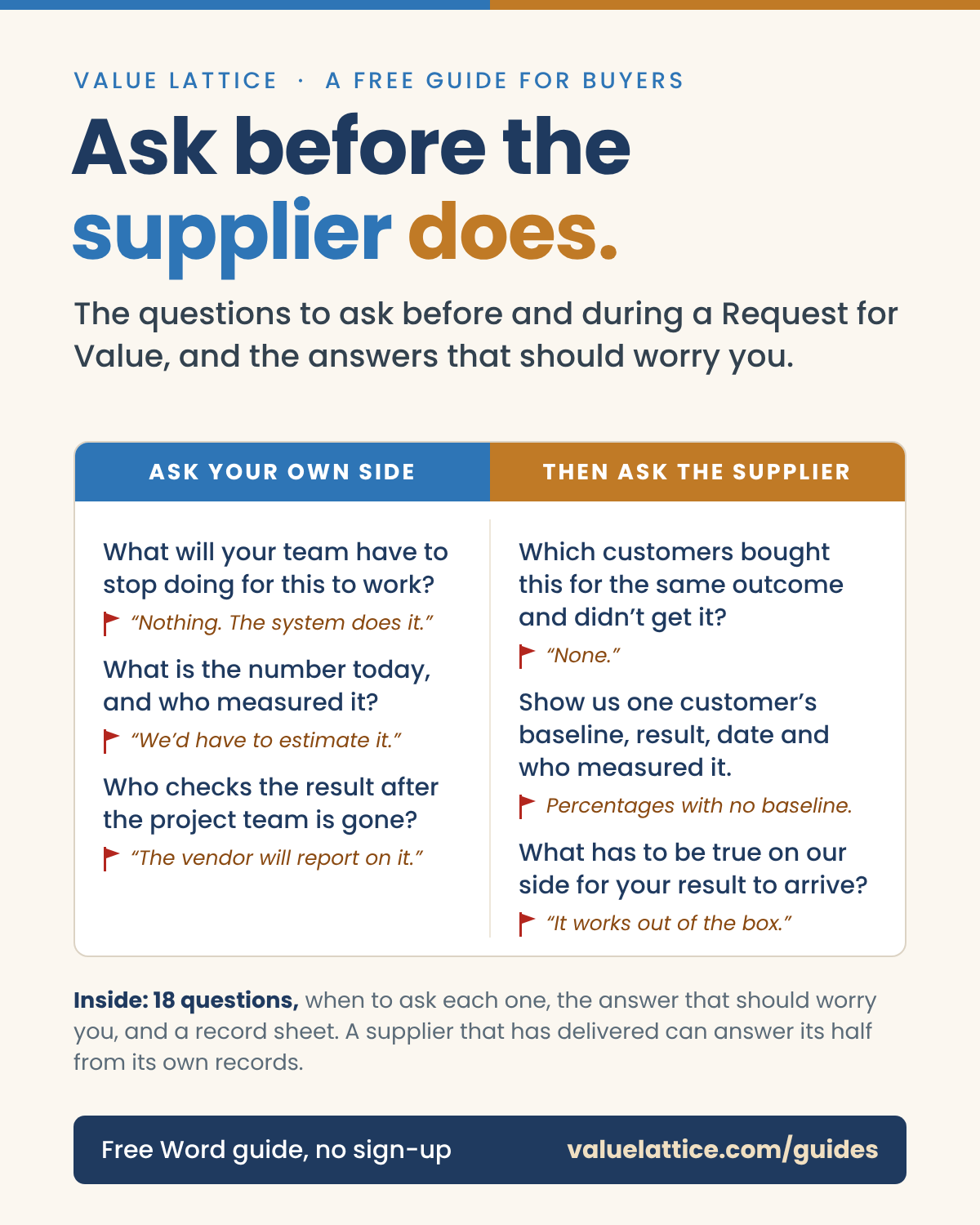
The buyer can run the same discipline on itself, before a supplier is in the room. Ask the operations lead what their team will have to stop doing for this to work. Ask finance what the number is today and who measured it. When the answer comes back “nothing, the system does it” or “we’d have to estimate it,” you’ve found the part of the Request for Value that’s still missing.
Then ask the suppliers. Which customers bought this for the same outcome and didn’t get it? Show us one customer’s baseline, the result, the date, and who measured it. A supplier that has delivered can answer both from its own records.
I put the questions, when to ask them and the answers that should worry you into one free guide, with a record sheet to keep the answers: https://valuelattice.com/guides/#rfv-questions
October 16, 2026
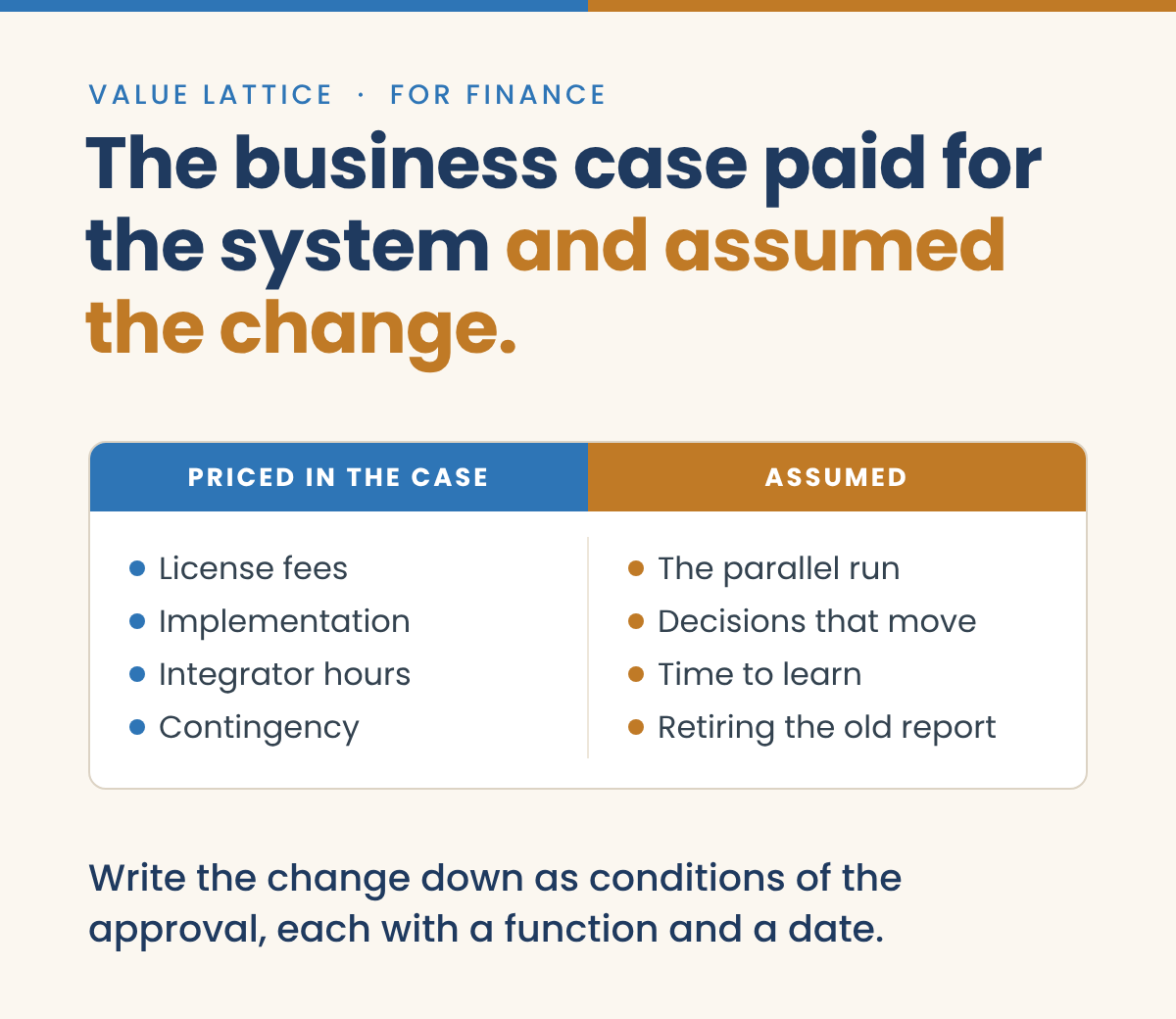
Most investment cases price the system carefully and assume the change.
License, implementation, integrator hours, contingency. Finance tests every line of it. The cost of the organization actually working differently rarely makes the page the committee approves: the parallel run, the decisions that move to new people, the old report somebody has to stop producing.
It's hard to put in dollars, and a made-up figure is worse than none. It goes in fine as conditions. What the business itself has to do for the returns to arrive, each one with a function and a date.
Then the committee knows it is approving two things. The review a year later checks the conditions before anyone argues about the technology. And a vendor that delivers has a record that separates its part from yours.
I wrote it up for finance readers here: https://valuelattice.com/the-business-case-paid-for-the-system-and-assumed-the-change/
October 9, 2026
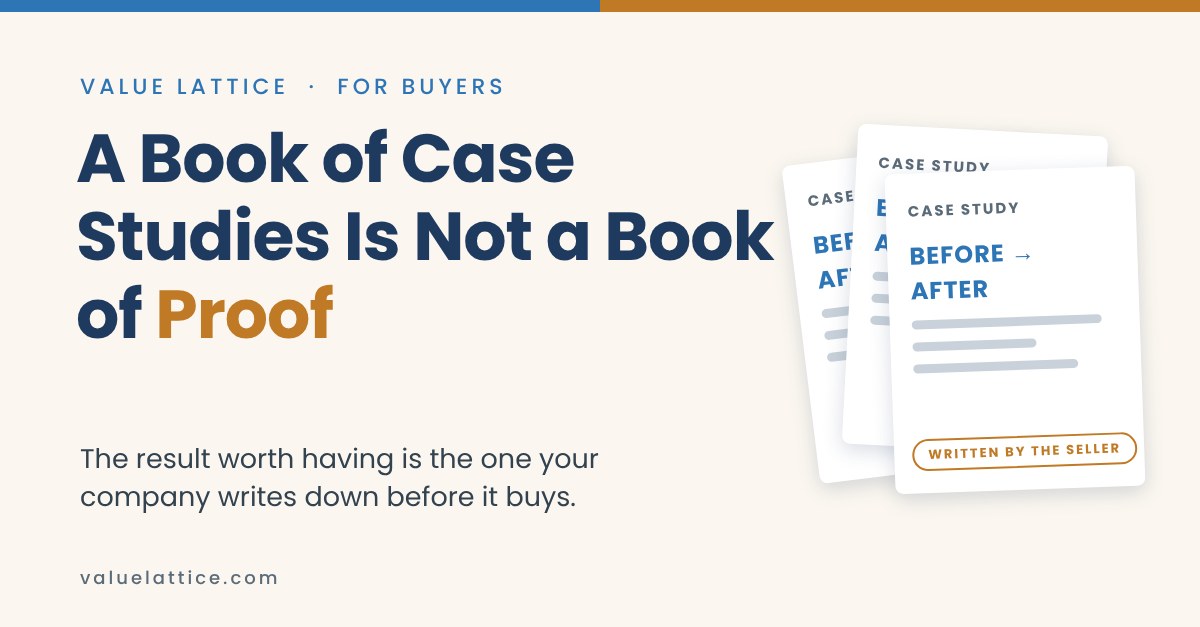
A book of AI case studies is still a book of case studies.
Every week another free guide shows up with a hundred AI success stories in it: before-and-after numbers, ROI benchmarks, the works. Some of it is useful for ideas, and I read them that way.
What they can't be is proof. Nearly every one of those numbers was written by the vendor that sold the system or the consultancy that put it in. The baseline got picked after the project started, and nobody went back a year later. We built plenty of these business cases on the vendor side, so I know how the months get chosen.
The only result that would count for your company is one your company wrote down before it bought: what the purchase has to do, measured from your own baseline, by a date you set, and checked by your side afterward.
I wrote about what would make any of those examples count, and what a vendor with real results gets out of it: https://valuelattice.com/a-book-of-case-studies-is-not-a-book-of-proof/
Use the libraries for ideas, and start your own page before the next contract gets signed.
September 28, 2026
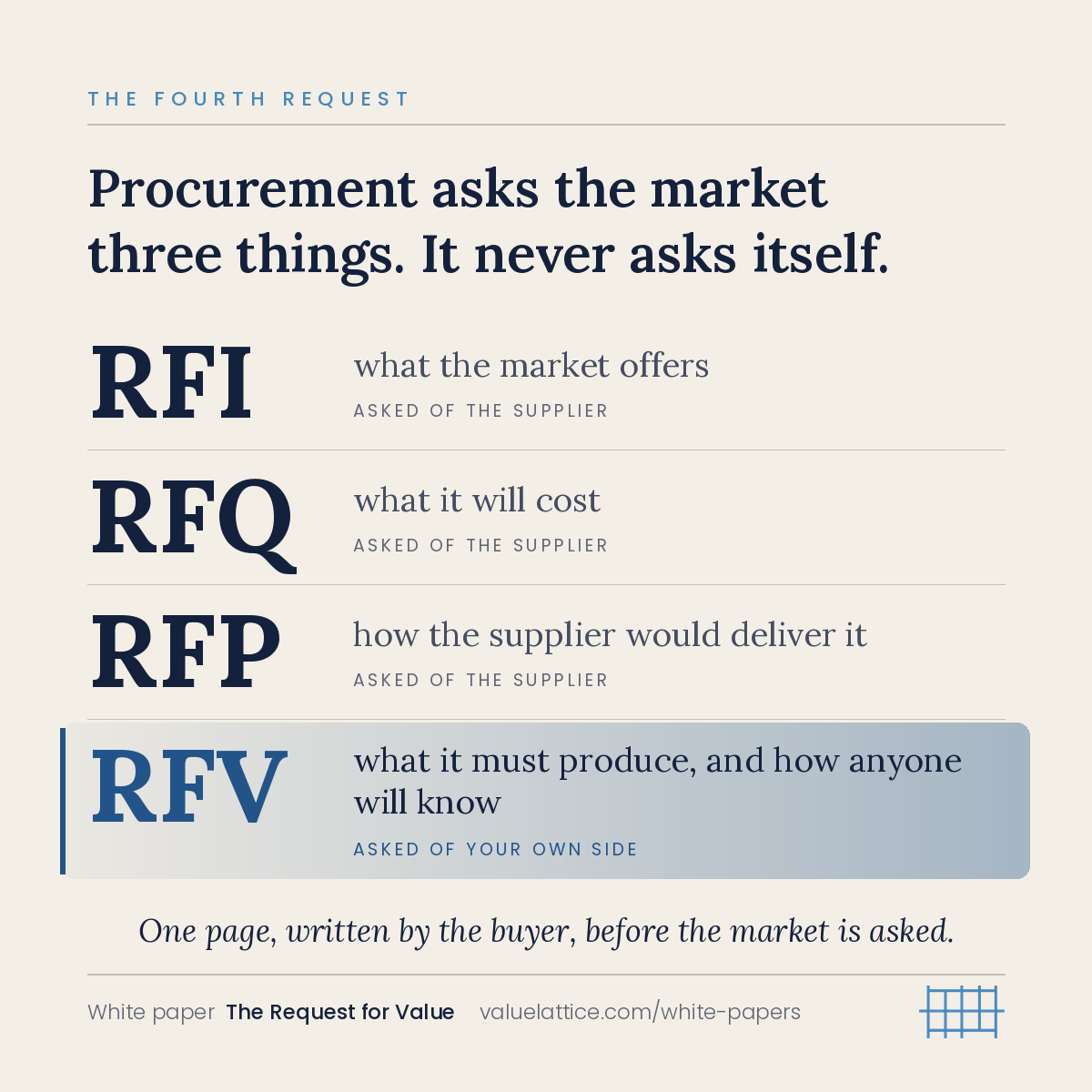
Procurement has a request for information, one for quotation, and one for proposal. It has never had one for value.
The three it has all face the same direction. What the market offers. What it will cost. How the supplier would deliver it. All three are asked of the supplier. None makes the buyer's own side write down what the purchase has to produce, or how anyone will know.
So the definition of success arrives from the only party that wrote one down, and at renewal the organization opens a file it never authored.
The fourth request is one page, written by the business owner before the market is engaged: the outcomes, in the organization's own terms; the metrics, with a baseline and a date; the conditions that must hold on both sides; the evidence a supplier must provide for a claim to count; and how the responses will be compared, decided before they arrive.
The page attaches to the RFP. The contract references it. The renewal tests it. Nothing else is added. Vendors object once. Then they compete on it.
I call that page a Request for Value. It is one chapter of The Value Standard and the part a procurement team can issue next Monday, so I have put it in a working paper with the one-page form: https://valuelattice.com/white-papers/the-request-for-value/
The book is about what happens after the page exists: the decision that commits to it, the cadence that reviews against it, the audit that says whether the value arrived. The page comes first.
Governance Check: Locate the page in your last major purchase where your own side wrote what it had to produce. If the only such page came from the supplier, the purchase is being measured against its seller's definition of success.
September 25, 2026
Two frontier laboratories shipped new models on Tuesday, minutes apart, and both releases led with price. The reading everywhere was the same: intelligence is being commoditized, priced like cloud storage, more for less every quarter.
Cloud storage is a commodity because the unit holds still. A gigabyte is a gigabyte whoever sells it. A token is a different kind of unit, because how many of them a task consumes is a product decision made by the seller.
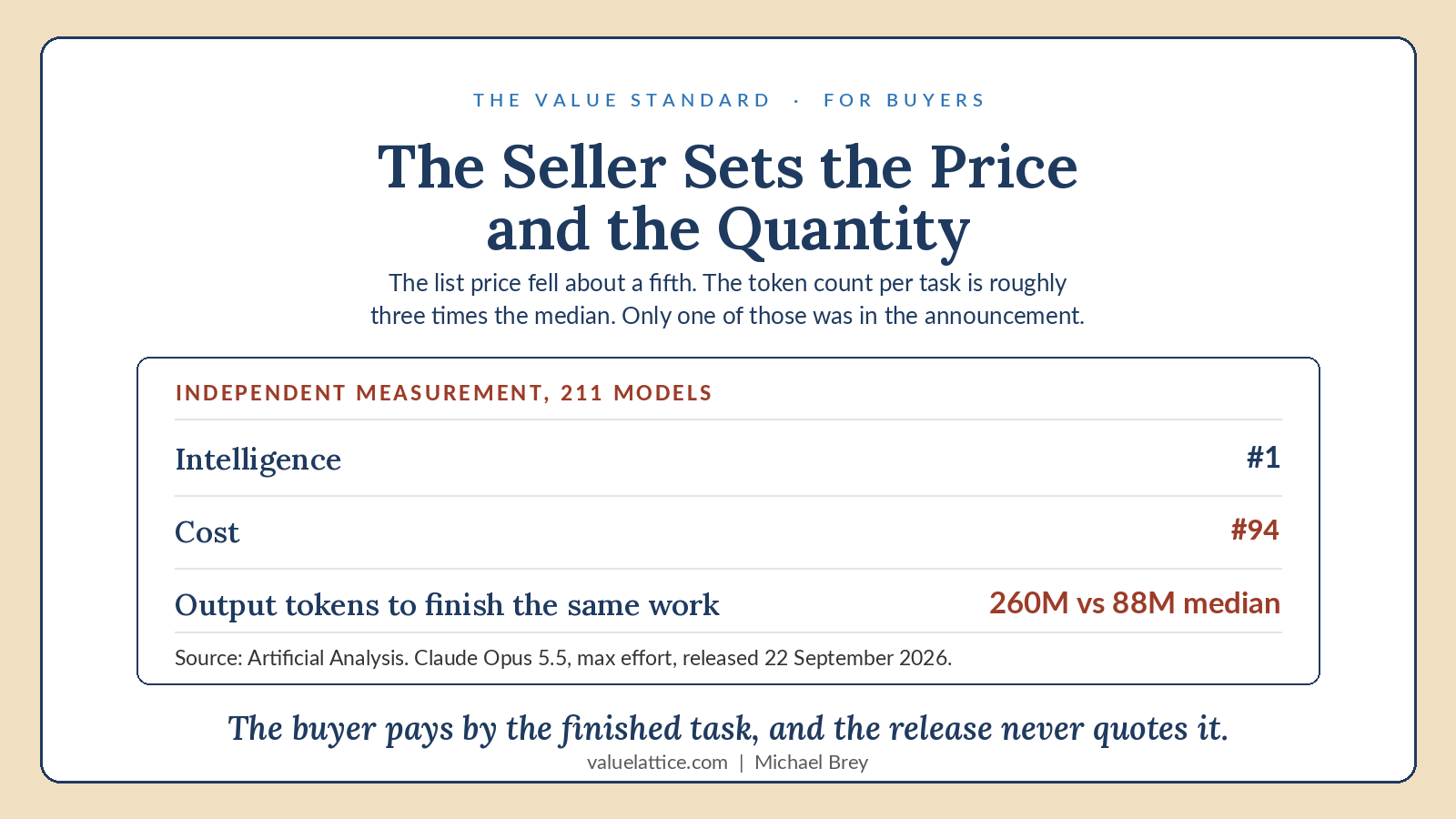
Artificial Analysis measures models itself rather than reporting what the laboratories report about themselves. On its index the new leading model ranks first of two hundred and eleven on intelligence, and ninety-fourth on cost. The reason sits in a line most readers scroll past. Finishing the same evaluations, it generated 260 million output tokens against a median of 88 million.
Roughly three times the output, billed at the expensive end of the meter. The list price came down about a fifth over the same release.
The seller sets both the price and the quantity, and only the price was in the announcement.
None of that makes it a bad buy, and the vendor's own claim that it costs less to run than its predecessor is not in dispute. It answers a different question than the one a buyer is asking. Cheaper than last year's version and cheap are separate statements, and only the first is the seller's to define.
I wrote about the measurement nobody in the purchase paid for: https://valuelattice.com/the-seller-sets-the-price-and-the-quantity/
Governance Check: Take any per-unit price your organization agreed this year. Find out who controls how many units a finished task consumes. If that is the supplier, you negotiated one number and you pay another.
For posts that run as a series, see Post Series.
The Standards Ledger
Some topics need more room than a blog post. Those go into The Standards Ledger, a free newsletter by Michael Brey, sent through Substack. Subscribers get one long essay by email about every six to eight weeks, and each issue also stays online to read later. It is written for the people who approve purchases and answer for what they deliver. Unsubscribe anytime.
On LinkedIn, follow Michael Brey or the Value Lattice page.